De La Salle College of St. Benilde
De La Salle-College of Saint Benilde Inc. (DLS-CSB or Benilde) is a non-stock, non-profit organization offering secondary and tertiary education in Manila and Antipolo, Philippines. Benilde was founded in 1988 and is a member of De La Salle Philippines.
Included in their programs is the implementation of the Expanded Tertiary Education Equivalency and Accreditation Program (ETEEAP), being one of the hundreds of colleges and universities in the Philippines that were deputized by the Commission on Higher Education (CHED).
To get the complete information about their ETEEAP, please read the following information that will guide you to the right direction.
Very Important: Please transact with the official representative of the AU ETEEAP Department. Never entertain anyone who claims to be one outside their ETEEAP office (not even with one claiming to be a faculty member or a graduate of their ETEEAP) to avoid getting scammed. Use the information provided below to get in touch with them.
Disclaimer: These is not the official website and/or Facebook Page of Benilde. If you need the complete details of their ETEEAP and how to contact them, please use the following information that will guide you to the right direction.
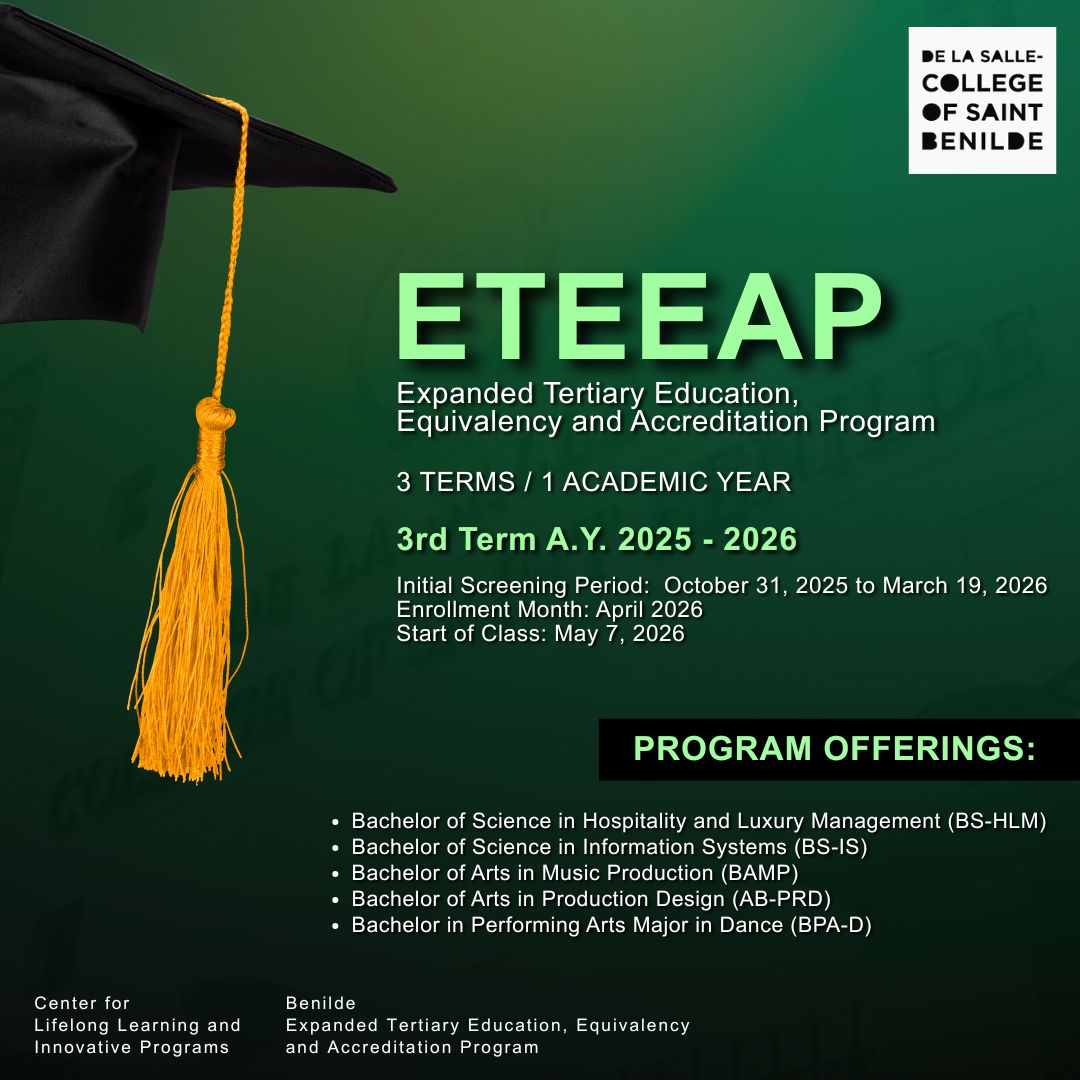
Offered Degree Programs under Benilde’s ETEEAP
- BS-Hospitality and Luxury Management (BS-HLM)
- BS-Information Systems (BS-IS)
- AB-Production Design (ABPRD)
- AB-Music Production (BAMP)
- Bachelor of Performing Arts in Dance (BPAD)
Tuition and Other Fees
This is one of the first question prospective candidates always ask. This information can be obtained from the school so please contact the Benilde ETEEAP Administration directly.
For the complete details of the above programs including requirements, fees and other relevant information, please contact the school directly using the appropriate Contact Details Links below.
Important: Please transact with the official representative of the Benilde ETEEAP Department. Never entertain anyone who claims to be one outside their ETEEAP office (not even with one claiming to be a faculty member or a graduate of their ETEEAP) to avoid getting scammed (Yes, the ETEEAP was also penetrated by scammers). Use the information provided below to get in touch with them.
Disclaimer: These is not the official website and/or Facebook Page of Benilde. If you need the complete details of their site and page, please use the above-mentioned links.
Benilde ETEEAP Learning Modality
Benilde implements and delivers ETEEAP using the blended online-modular modality. Please see below the differences of the four learning systems used by different schools. You may also visit this link for the comprehensive discussion.
1) Face to face or in-person (F2F or IP)
– Pupunta ang estudyante sa school at doon mismo mag-aral kasabay ng iba pang mga estudyante. Ito ay tinatawag na SYNCHRONOUS LEARNING.
2) Online
– Hindi pupunta sa school ang estudyante ngunit mag-aaral din ito kasabay ng iba sa pamamagitan ng mga online learning tools tulad ng Zoom, Google Meet at Classroom, Messenger at iba pang virtual conference tools. SYNCHRONOUS LEARNING din ito.
3) Modular
– Hindi pupunta sa school o sa online ang estudyante kundi matatanggap niya ang mga lesson niya sa door to door delivery, email o sa school portal at gagawin niya sa sariling schedule ang pag-aaral saka niya i-submit ang mga assignment niya sa pareho ding paraan ng pag-deliver sa kanya. Ito ay tinatawag na ASYNCHRONOUS LEARNING.
4) Hybrid
– Ito ay anumang combination ng number 1, 2 at 3. Mayroong hybrid online-modular (HOM) at hybrid inperson-modular (HIM) o hybrid face-to-face and modular (HFM).
SYNCHRONOUS LEARNING – Sabay-sabay na mag-aral ang mga estudyante sa loob ng classroom o iba pang bahagi ng school campus, o sa pamamagitan ng mga virtual conference tools tulad ng Zoom, Google Meet, at Messenger.
ASYNCHRONOUS LEARNING – Hindi sabay-sabay ang pag-aaral at tatapusin ng estudyante ang mga assignment niya sa module na ipapadala sa kanya, sa pag log-in sa school portal o LMS, o sa Google Classroom ng school.
Residency Period
Individuals enrolled under the Program are required to have minimum residency of six (6) months. This means that even if your enrolled subjects are completed in less than 6 months, you can not apply for graduation, even if you have complied with all the requirements. Maximum residency is two years when and if you have not completed all your requirements, you need to undergo a re-evaluation and another enrollment procedure.
Contact Details Links
- Website link (Home Page): https://www.benilde.edu.ph/
- Website link (ETEEAP Page): https://www.benilde.edu.ph/programs/eteeap/
- Facebook ETEEAP page: Click/Tap on this link
- Offered Programs: Click/Tap on this link
- ETEEAP Requirements: Click/Tap on this link
- Qualifications/Requirements: Click/Tap on this link
- Phone: 0908 865 6704
- Email: eteeap@benilde.edu.ph
- ETEEAP Admin Facebook: Bourne Piccio (Tap to the profile)
Latest Update (AY2025-26)
Important: Please transact with the official representative of the Benilde ETEEAP Department. Never entertain anyone who claims to be one outside their ETEEAP office (not even with one claiming to be a faculty member or a graduate of their ETEEAP) to avoid getting scammed (Yes, the ETEEAP was also penetrated by scammers).
Disclaimer: These is not the official website and/or Facebook Page of Benilde. If you need the complete details of their site and page, please use the above-mentioned links.
For questions and needed clarifications, please go to our comments page here.
Please click/tap here to our comments page.