June 08, 2026
Featured School: University of the Cordilleras
PSU BIT Details
Beginners’ Free Pre-evaluation
ETEEAP DHEI’s 2026
ETEEAP for Beginners
PSU Evaluation Application
Programs for Teachers and TA’s
ETEEAP vs Non-ETEEAP
ETEEAP Preparation Assistance
Questions from our Visitors
ETEEAP
Philippines

Posts

2021
Aug
19

eBooks

Share this page

For our visitors who love to read novels and other learning materials, we added some links and pages for your enjoyment. We have partnered with friends who authored and published their books, and are very much willing to let our visitors read them for free. These books contain accounts of their writers’ experiences as they participated in different endeavors of life which many had become part of history. Enjoy your virtual adventure with them.

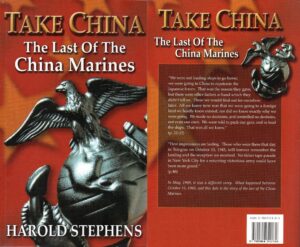
The Author as a WW2 US Marine

When the Second World War ended in 1945, the 6th Marine Division, just coming from the Battle of Okinawa, was in Guam. This was the only Marine division that was formed and disbanded overseas and never set foot in the United States. The announcement of Japan’s surrender was a relief that finally the marines can go back to their families.

However a new instruction and assignment was issued. They were going to China. What was this Presidential Unit Citation awardee going to do in China?

READ this book…

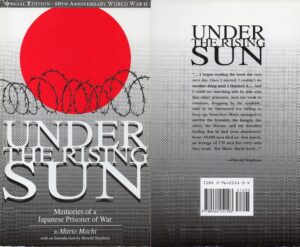
Bataan Death March

Army private Mario Machi was a survivor of the notorious Bataan Death March after the Japanese invasion of the Philippines one day after Pearl Harbor. He was among the first American enlisted troops that was sent to the Philippines in mid-1941. Under the command of General Douglas MacArthur, they defended Bataan and Corregidor until their surrender, which eventually lead to the infamous death march.

This is one of the first-hand stories you will ever find.

Feel the author’s ordeal.

READ this book…

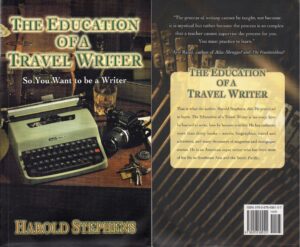
How to Become One

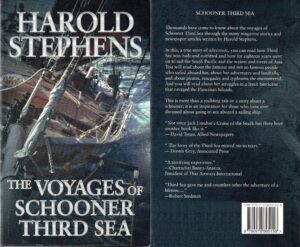
Harold Stephens is a prolific writer and dedicated to his profession. He has written more than thirty books-travel, adventure, biographies and novels-and over four thousand magazine and newspaper stories, TV and video scripts, movie documentaries, and just about anything that has to do with the written word.

“You’ll never make it as a writer,” editors told him, as did most everyone else. How did he beat the odds?

Good read for aspiring writers and bloggers.

READ this book…

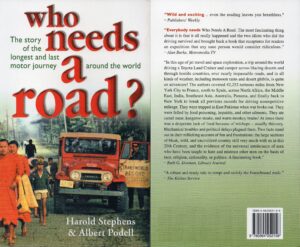
The Only Land Travel

“a trip around the world driving  a Toyota Land Cruiser and camper across blazing deserts and through hostile countries, over nearly impassable roads, and in all kinds of weather, including monsoon rains and desert ghiblis, is quite an adventure! The authors covered 42,252 tortuous miles from New York City to France, south to Spain, across North Africa, the Middle East, India, Southeast Asia, Australia, Panama, and finally back to New York to break all previous records for driving non-repetitive mileage.
Ruth G. Dorman, Library Journal

READ this book…

Navigating the Ocean

Besides circumnavigating the earth with a 4WD Jeep and a Toyota Land Cruiser, our author, Harold Stephens, always wanted to build his own boat and travel around the world with it, conquering earth’s huge bodies of water. In the end, it was not just him but his entire family enjoyed this adventure. How did he get into this in the first place? Who influenced him?

Let’s join him as he relates how he started.

READ this book…

The Author’s Adventures

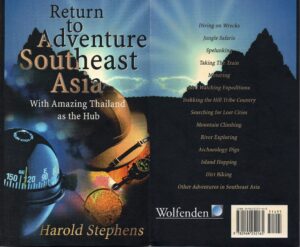
After his discharge from the marines, our author, Steve, returned to his family in the US to enjoy his benefits under the GI bill. Got a job and started a family. However, his love for adventure and writing kept on pestering him prompting him to go back to Asia and other places he had been during the war.

This book is a collection of true stories and true happenings. The places are real and the incidents took place as the author can best remember them. Let us join him and feel the adventures within your comfort zone.

READ this book…

The Life of an Artist

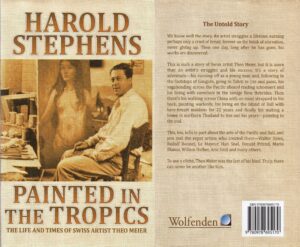
We know well the story. An artist struggles a lifetime, earning perhaps only a crust of bread, forever on the brink of starvation, never giving up. Then one day, long after he has gone, his works are discovered.

This is such a story of Swiss artist Theo Meier, but it is more than an artist’s struggles and his success, It’s a story of adventure-his running off as a young man and, following in the footsteps of Gauguin, going to Tahiti to live and paint, his vagabonding across the Pacific aboard trading schooners and his living with cannibals in the savage New Hebrides.

READ this book…

The 17th Century Thailand

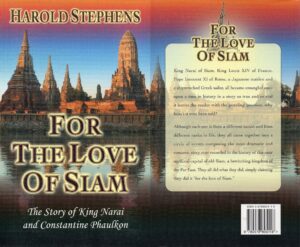
King Narai of Siam, King Louis XIV of France, Pope Innocent XI of Rome, a Japanese maiden and a shipwrecked Greek sailor, all become entangled once upon a time in history in a story so true and so real it leaves the reader with puzzling question, why hasn’t it ever been told?

This is the story of the old kingdom of Thailand, then called Siam, during King Narai’s reign, in its former capital Ayutthaya before the Burmese destroyed it prompting the government to move its capital down south which was then called Bangkok by the Dutch.

READ this book…

____________________________

Share this page
2020
Dec
24

ETEEAP and ALS

Share this page

ETEEAP was introduced by the Philippine government purposely for Filipinos who were forced forego their college or university education due to circumstances beyond their control. It was  established by the Executive Order Number 330 (EO#330) signed by former Philippine President Fidel V. Ramos on May 10, 1996. But there was a precursor to the ETEEAP.

Prior to the signing of EO#330 was a part of the 1987 Philippine Constitution Governance Act for Basic Education otherwise known as Republic Act 9155 (RA955) which established the Alternative Learning System (ALS).

The official website of the Department of Education (DepEd) in the Philippines describes the reason why these systems were established this way: “Many Filipinos do not have a chance to attend and finish formal basic education (Grades 1-6 and Year 1-4) due to many reasons. Some drop out from schools while some do not have schools in their communities. Since every Filipino has a right to free basic education, the Government establishes ALS to provide all Filipinos the chance to have access to and complete basic education in a mode that fits their distinct situations and needs.”

How does the system work?

The same source explains, “There are two major programs on ALS that are being implemented by the Department of Education, through the Bureau of Alternative Learning System (BALS). One is the Basic Literacy Program and the other is the Continuing Education Program – Accreditation and Equivalency (A&E).  Both programs are modular and flexible. This means that learning can take place anytime and any place, depending on the convenience and availability of the learners.”

The difference between the Formal Education System and the Alternative Education System is that “Formal Education system is classroom-based, managed by trained formal school teachers” while “ALS Non-formal Education happens outside the classroom, community-based, usually conducted at community learning centers, barangay multi-purpose hall, libraries or at home, managed by ALS learning facilitators, such as mobile teachers, district ALS Coordinators, instructional managers at an agreed schedule and venue between the learners and facilitators.”

In the above description the ALS has two sections. The first one is the Basic Literacy Program which is intended for those who have not completed their basic education (Grade 1 to Grade 10). The recent implementation of the K-12 system for the Philippines to comply with global standard added the senior high school level which is Grade 11 and Grade 12. The students’ qualification to graduate (In elementary, secondary or senior high school) is evaluated by series of examinations prepared and administered by the DepEd at designated place and time throughout the country. Outside the Philippines, these are mostly held at Philippine Embassies or Consulates. These examinations will ensure that the students are qualified to enter the next level of their education. As for the Continuing Education Program-Accreditation and Equivalency, the ETEEAP comes into play for students who wish to continue on acquiring tertiary education or higher learning.

In the Philippines the basic education is taken care of by the Department of Education (DepEd) while the Tertiary or higher education is under the supervision and implementation of the Commission on Higher Education (CHEd).

To sum it up, ALS is intended for adults who have not completed their basic education (Elementary and/or Secondary as far as Grade 10). Then they can continue to take up senior high school. ETEEAP on the other hand is for adults who completed their secondary education but were not able to finish their college degree. There are minimum age requirements for these.

Who can benefit from the ETEEAP?

Anyone who has completed secondary education through the Formal Education System or the Alternative Learning System and did not have a chance to start or complete a college or university degree can benefit from the ETEEAP. But how does the system work? How much is the cost? What are the requirements? Other articles on this site provide answers and more information on these questions. You can find them on the links below.


References:
https://www.deped.gov.ph/k-to-12/inclusive-education/about-alternative-learning-system/
https://eteeap.org/

Share this page