The evaluation is the very first part of the assessment process that ETEEAP DHEIs implement to determine if the applicants are eligible to enroll in their program.
The schools usually require the applicants to submit between 1 and 3 sets of their portfolio (credentials), one consisting of all the original documents, and the other two are photocopies. Other schools require only 1 set of photocopies. One of these (if more than one) will be kept in the permanent student record of the school for future reference, just like they do on regular program students.
Along with the submitted documents is the corresponding evaluation fee that ranges between PHP5,000.00 and PHP25,000.00. Some private schools require this fee upfront as soon as the applicants submit their letter of intent along with their application form and other credentials. For others, this is paid if the student passed the pre-evaluation and already qualified for the next step of the student’s application which is usually the interview with the panel of experts. For the latter, the student already qualified and the evaluation panel interview is only to determine the level of expertise of the applicant which is needed by the school to appropriate the equivalent courses (subjects and units) that will be covered by his/her work experiences and informal trainings. Then the school will determine the courses the student needs to enroll to complete all the requirements to be awarded a bachelor’s degree.
Does paying the evaluation fee ensure that applicants will be accepted? Yes and No and that depends on the school. In the previous paragraph, there are two ways schools collect the evaluation/assessment fee. With the former, it is still uncertain, but with the latter as explained the student already passed the pre-evaluation and the fee is only for the final determination of how many subjects the student still needs to enroll. Is there still a possibility that the applicant will fail in this stage? Yes if the panel notices inconsistencies in the applicant’s statements and answers to their queries, if they find out the applicant is lying, and/or if they find out that the applicant submitted fraudulent documents.
The evaluation process is when and where the applicants’ credentials are examined and scrutinized by the industry experts in the field the applicants are requesting to enroll in. These experts could be the professors of the specified field, or external. The evaluation is not part of their paid job description, and therefore should be paid. Thus the evaluation fee, and therefore is not refundable in most cases, whether the applicants passed or failed the evaluation because the services (which is evaluating the applicant) has been delivered. If the applicants fail, most, if not all, do not refund.
If the applicants passed the evaluation and are accepted, the fee is normally deductible to the whole package fee of the program.
Some schools, especially state universities, do not require evaluation fees upfront. These will only be paid if the applicants passed the evaluation. These are referred to as ‘Evaluation Fee’ or ‘ETEEAP Accreditation Fee’ (either or both appear separately) in the assessment form the students will receive to continue with their enrollment process.
To avoid getting scammed, the applicants are advised to pay these fees directly at the school cashier, or any designated payment system the school has instructed them.
Para saan ang Evaluation, o Assessment at ETEEAP fee?
Ang EVALUATION ay ang pinakaunang prossesso ng assessment na ginagawa ng school para tingnan at busisiin ang mga credential ng mga aplikante kung eligible silang mag-enroll sa ETEEAP (Yan yung ibig sabihin ng Equivalency and Accreditation sa acronym na ETEEAP). Ibig sabihin, pwedeng pumasa o bumagsak ang aplikante sa prossesso na ito.
Kapag ang school ay nag-require ng evaluation/assessment fee bago nila umpisahan ang prossesso, yan ay non-refundable sa karamihang school (baka sa lahat pa nga ng school, at karamihan ay private colleges at universities), pumasa ka man o hindi. May ibang school na saka na lang magbayad ng evaluation fee kung tapos na at pumasa sa pre-evaluation (Karamihan ay state universities, pero may mga private institutions naman na mas considerate at ‘pay only if you passed the evaluation’). Ang tawag sa babayaran na ito sa assessment form ay ‘Evaluation Fee’ o kaya ay ‘ETEEAP Accreditation Fee’. Sa ibang kaso ay magkahiwalay na makikita itong dalawang impormasyon.
Kapag pumasa sa evaluation ay deductible ang evaluation fee na babayaran sa total amount ng buong program (kung upfront o binayaran bago mag-umpisa ang evaluation).
Bakit may ganitong fee?
Dahil ang mga mag-eevaluate at mga expert sa field ay hindi kasama sa kanilang suweldo ang trabaho na ito kaya kailangan silang bayaran regardless kung pumasa o hindi ang applicant (Hindi laging employed sa school ang mga evaluator. Minsan ay external ang mga ito na pupunta lang sa school para mag-evaluate ng mga credential ng mga applicant sa ETEEAP. )
Ang range ng evaluation fee ay 5k hanggang 25k depende sa school.
Para hindi ma-scam ay doon sa school mismo magbayad, hindi sa agent. O mag-verify muna sa school kung pwedeng sa agent ibigay ang bayad.
Learning Modality – Full self-paced (self-guided) modular (No face-to-face and no synchronous online). PSU earned and maintains the requirement to implement this learning modality for their ETEEAP students.
Degree completion – 6 months to 1 year (Dependent on students’ diligence and the time and effort they put into the program)
Other information and guidance discussed on this page:
Total cost with breakdown
List of requirements
Application procedure
Enrollment procedure
Assistance for OFW and local applicants
Assistance for DH and caregivers
Re-evaluation process
Our track record
Please carefully read everything on this page to understand the whole process.
PSU ETEEAP Application Procedure
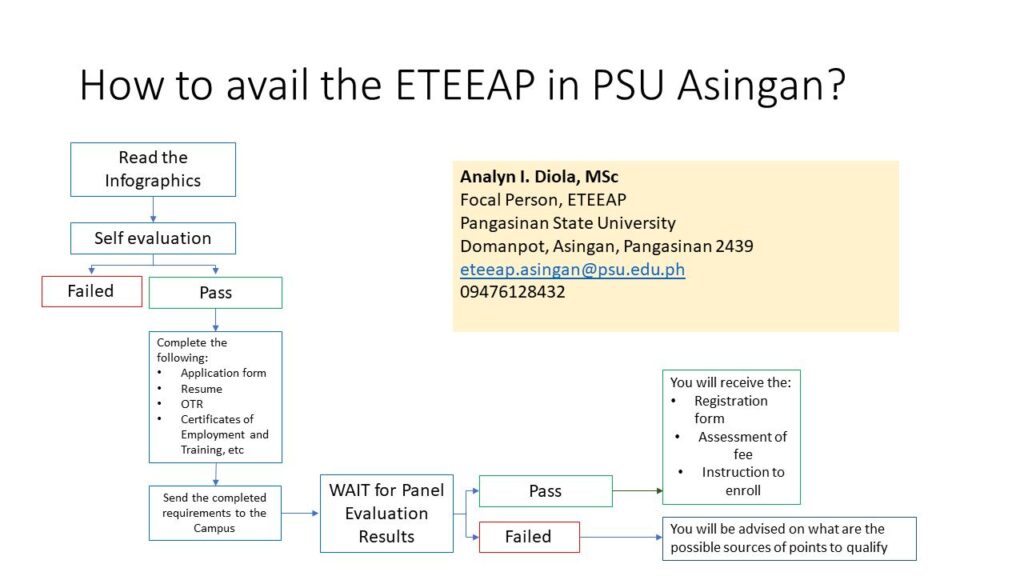
For new applicants, PSU requires you to submit your printed credentials (1 set only)in a long clear book for them to evaluate your qualifications. Electronic or soft copies sent through email are not entertained, and so with enquiries sent to the focal person’s Private Messenger, especially those that just describe work experiences, ETEEAP application form only, CV only and other partial information just to verify if it’s worth preparing all the requirements. The complete set of printed requirements organized into a portfolio should be sent to the school campus for the evaluation in the way already described above. We have the list of requirements at the bottom of this page but before you proceed there, we would advice you to keep on reading the following policies, procedures and instructions.
The Challenge for New Applicants
It has been noticed that many of ETEEAP applicants (especially OFWs) had difficulties in, or did not have convenient access to, printing and shipping their documents. PSU earlier had a special way of accommodating these applicants by taking the burden of printing the electronic copies send to them. This they were doing for free, or for a minimal fee for the extra services.
However, since these needed tasks are primarily the applicants’ responsibility as policy, this extra task (which also compromised the school’s staff quality time supposed to be dedicated to their related work on campus) can no longer be accommodated by their ETEEAP staff and their facility. It was discontinued in the early part of 2024.
Alternative Solution
That being said, we are delighted to announce that we made an arrangement with, and asked permission from, the PSU-Asingan ETEEAP administration to provide assistance to those who wish to enroll at their campus. Also in January 2025, we extended these services to enrolled students who need assistance in printing ang shipping their modules for submission to the PSU campus.
This arrangement was setup to help their interested applicants and enrollees who cannot print their documents, as well as shipping them to PSU is a complicated and expensive process for them. These services will benefit OFWs and other local applicants who have no printing facilities and where shipping documents to PSU may take longer, pose the risk of loss along the way as well as other factors. Also in most cases, those who thought they have all the needed requirements still failed to earn the minimum evaluation score to be able to enroll. And this is one reason why we offer our services to minimize the frustration and disappointment of getting into a perceived dead end.
The said services can help you in the following aspects:
Saves time in printing your documents.
Protect your original documents from getting lost as you don’t need to submit them.
Saves money and time on notarization of your documents. PSU does not require notarization of documents.
Saves time and cost on shipping your documents.
Assurance that all required documents are submitted, and you are given proper advice on what to submit as well as those you still need to submit.
Eliminates submission of hard copies of your documents as you will only send the soft or electronic copies to us and we will do the printing, binding and shipping for you.
If you fail the initial evaluation, we provide guidance on what to do to pass the re-evaluation, along with the coordination between the applicant and the school.
Before you move on, please read the following:
Accountability release (Disclaimer):
First, we would like to repeat that this proposal and offer is not sanctioned by PSU or any other school that we made agreement with. Also, we are not recruiting applicants, or were authorized by PSU to recruit applicants, although we suggest PSU’s programs when we see it applies to their work experiences. This is our own services that we are extending to those who need them, if they wish to avail. Although PSU allowed us to come up with these services, they are not in any way partner with us and we want to clear them of any responsibility from problems arising with the arrangement with our clients.
Second, this does not guarantee your automatic enrollment with PSU, or other schools we are (or will be) working with, nor will entitle you advantage over other applicants. This is just one process of your application, and the rest of the procedure still depends on you.
Third, there are two other ways to submit your documents to PSU: a) First, personally deliver the printed documents in a clear book to PSU (Walk-in). b) Second, ship the folder to PSU via DHL/FedEx/LBC/JRS/J&T/EMS or other forwarding companies. c) Third, If the other two do not work, or are inconvenient, for you then this third option may work, which is to avail of our document printing, shipping and consultancy services for PSU applicants.
Please read on for the third option procedure.
For Domestic Helpers(DH) and Caregivers, we have another assistance system intended for you. Please go to this link, or click/tap on the image below.
Our Services
Now let’s go back to the services that we are offering.
Here is the procedure:
First Option: Expanded Application Assistance Services (EAAS) This is also called Continuous Assistance on Documents Preparation Until Enrollment (CADPUE) A fee of 6,000.00 is required for this service, and is paid upon confirmation that you want to avail of our services. This fee covers the following:
a) Assistance for applicants who still need help and guidance in preparing their requirements. We also conduct orientation on Zoom, if needed. b) Organizing submitted documents, print them and bind them into a portfolio through the procedure described in the declaration and guide forms. c) Coordination with PSU for follow up, and for additional requirements that can be coursed through us after submission of the first set of credentials. d) Guidance in requirement preparation until enrollment. e) Assistance on reevaluation if the applicant fails the first evaluation.
– Just to be clear on EAAS that it is not for us to create documents for you but to assist you in preparing and securing your requirements (we do not produce, or help in creating, fake certificates and credentials nor alter those acquired from legitimate institutions). This is to ensure that someone will be assigned to dedicate time in assisting the applicant’s preparation and guidance in organizing and completing their requirements until their approval for enrollment.
Second Option:PSO (Print and Ship Only) – A fee of 3,000.00 is required for these services. This is called printing to shipping only option. This is paid upon confirmation that you want to avail of our services.
This fee covers organizing submitted documents into a portfolio through the procedure described in the declaration and guide forms. This does not include consultancy in the preparation stage (First Option-PHP6,000.00), which means we won’t assist or answer questions on your documents whether or not they can be included in your portfolio. This option is for those who are already familiar with the requirements and just need printing and shipping them to the evaluation team. Additionally, once your portfolio was shipped to PSU, it will be between you and the school including follow up for evaluation results that should be directed to them.
In the event that you failed your initial evaluation and need additional documents or requirements, these should also be submitted to them directly without involving us. But if you need re-evaluation assistance, you need to pay an additional amount of PHP 3,000.00. Note: If you have already paid for the EAAS, this no longer applies and no longer needed as option 1 covers both services.
If you failed your first evaluation but initially did not pay for the EAAS (or only availed of the PPO) and need assistance for the reevaluation, you may scroll down to the section for the procedure.
Important (Please read these first): a) Please fill out the Applicant Declaration Form below to signify your acceptance and agreement with the terms and conditions of these services. You will also find the instruction on how you will pay the service fee in that form. b) Please do a re-check if your work experience or background is properly aligned to PSU’s offered degrees under the ETEEAP (You can see their offered degrees along with the requirements below). If you realize that this is not the case after your payment has been made and you request for a refund, we will only send 25% back to you within 2 days from the date of your payment. Beyond that, your application will be added to the dormant applicants who are allowed to request for re-evaluation without any additional fees within one year. After one year, the payment will be forfeited. This is to ensure that you really understood the whole system before you process your application. (Please see refund policy below). c) If your experience is aligned with PSU’s program and after payment you decide not to continue for any reason, we will not refund but your application will be put on hold or pending until you are ready to continue. After one year, the fee will be forfeited.
After payment, please send the confirmation slip to this email address: psu@eteeap.org We will provide another link to a form which will guide you throughout the whole process of submitting all your documents electronically for pre-evaluation. We will then print your documents, organize, bind and forward them to PSU if they are complete, otherwise we will advise you on any lacking documents/requirements.
Please note on refund: – If you realized that your work experience was not aligned with PSU’s programs and yet you paid for the services, you only have 48 hours from the actual time you paid to request for a refund. 25% of the total mount you paid will be refunded to you. The reason:You need to be serious, decided and determined in joining this program, and you are not just school-shopping.We are serious in assisting applicants and we mean business, and you should also be. – If your work experiences are aligned with PSU’s programs and you want to request for a refund on any reason, we won’t refund but instead move your application into the dormant applicants. You have one year from the date of your payment to resume your application, or your fee will be forfeited one year after the actual payment. If you decide later that you want to resume within that one year period, no additional fee will be required. Otherwise you need to restart after your fee’s forfeiture (One year after payment). The reason:You need to be serious, decided and determined in joining this program, and you are not just school-shopping.We are serious in assisting applicants and we mean business, and you should also be.
Either you pass or fail the pre-evaluation, we (or PSU) will inform you. Please note, however, that we cannot control and cannot provide timeline on how long the pre-evaluation will take, as this is dependent on the current activities of the school. It may take between three weeks and three months to know the result. In some cases, it may even take longer, on which we encourage you to be patient. – Here are the conditions on either scenario:
– If you pass the pre-evaluation, you will be informed by either PSU or us and further instructions will be provided on the next step you need to take at your end to complete your enrollment. – If you fail the pre-evaluation, and paid for the EAAS (PHP 6,000.00), we will continue to assist you if you only need to submit additional requirements and help you how to avail of them to complete the minimum score you need. No additional fee is required. However, if you initially paid for the “print and ship only option(PSO)“, you need to pay for an additional amount of PHP 3,000.00 for us to assist you further. –
If at this time you significantly fail (after all remedies have been exhausted) but eventually want to apply for re-evaluation after securing additional requirements, we will accommodate you and you will only be required to pay 50% of the above-described fees. You may also directly coordinate with PSU on the steps you need to take which does not require our involvement to save additional cost.
If you wish to avail of our services, you pay for one of the above options you have chosen. The payment procedure is in the declaration form with its link called PSU Assistance Applicant’s Declaration below. You need to open this and fill out the from.
Send the reference slip of your payment to the email address mentioned in the declaration form.
You will receive an acknowledgement reply to that email you will send, along with other instructions you need to follow.
Another separate email will be send to you with the complete procedure on how you submit your credentials for evaluation, along with other instructions you need to follow.
You will be provided further instructions as your application progresses.
If you agree with the above terms and conditions, please open and carefully follow the instructions in the form on the link below. Please click/tap on the link below.
If you want to see the requirements and documents you need to prepare, please scroll down. You will also see the current programs offered by PSU under the ETEEAP. Then you can come back and complete the declaration form to start processing your application.
If you availed of the Printing and Shipping Only (PSO), or personally delivered your documents (walk-in or by courier), but failed the evaluation and need, or wish to, avail of the re-evaluation assistance which is described as EAAS above, please click/tap on the agreement form in the link below for the procedure. You also need to pay the reevaluation assistance fee of PHP 3,000.00.
Here is the list of requirements you need to prepare:
The list in the table below are categorized with the corresponding maximum score of each category. You need to meet the minimum score of 60.00 points to be able to enroll in PSU’s ETEEAP programs.
Credentials
Maximum Score
Required Forms: – Application letter (Letter of Intent) (Sample here – https://eteeap.org/appltr) – CV or resume (Sample here – https://eteeap.org/cv) – ETEEAP Application Form (Download here – https://eteeap.org/appform) – Birth certificate (Proof of your citizenship) – ID (Passport, Driver’s license, etc.) – For female applicants (Surname discrepancy proof – Marriage certificate, etc.)
0.00
Education Background: – High school documents (Diploma at form 137/138) – College degree certificate and OTR/TOR and confirmation letter – Other degree certificates and OTR/TOR and certificate/diploma – Vocational courses completed (TESDA, Technical Schools, etc.)
20.00
Work Experiences: – COE of all relevant employees (Sample here – https://eteeap.org/coe) – Recommendation/verification letter from employer (Link to Sample Recommendation Letter) – OFW documents/contracts/visa/employment certificates. – DFR of all relevant employees if details were not provided on the COE (Sample here – https://eteeap.org/dfr) Note: 1 year in addition to the minimum 5 years work (which earns 15 points + 1 point for each additional year) experience in the field you want to apply for ETEEAP earns one point.Maximum of 15 points for the excess years.
30.00
Inventions, Innovations, Publications: (Local, national, international) – Inventions (scope of acceptance, patronage and recognition) – Innovations (scope of acceptance, patronage and recognition) – Publications (scope of acceptance, patronage and recognition)
5.00
Informal Training Attended: – Informal training certificates (LinkedIn, Google, Microsoft, Udemy, TES, etc.) – Training/Seminar certificates provided or sponsored by your employer.
5.00
Training You Managed and Organized: (Local, national, international) – Training/Seminars that you organized, participated and/or conducted. – Resource speaker/lecturer
10.00
Awards, Commendations and Citations: (Local, national, international) – Awards at work (Best employee, leader or the month, etc.) – Citations or commendations by government agencies, NGOs, church, etc. – This should be after completing secondary education, or age 18 and older.
10.00
Community Services Rendered or Participated in: (Local, national, international) – Rescue, front liner, emergency assistance, calamity response, first response, etc. – Community outreach, relief assistance and other similar activities – Government-initiated, Voluntary, NGO, or Church organized
10.00
Club and Other Professional Organization Membership: (Local, national, international) – Lion’s Club, Rotary Club, Eagles, Toastmasters, Red Cross, OWWA, etc. – Profession-related professional group – TODA, JODA, Uber Drivers’ Association – Shooters’ Association – Athletes Association
10.00
Licenses and Eligibilities: (Local, national, international) – Driver’s license – PRC – Civil Service Eligibility – Gun license
5.00
Total Score(Minimum should be 60.00)
_______
How are your credentials evaluated?
If you want to see how each of the above requirements are evaluated, you may visit the link below.
The table below has no hidden charges. Every detail you need to know as far as cost is concerned is all stated there, from the services we are offering above until your graduation. You can also see when you should pay each fee in the structure below.
DESCRIPTION
Cost
PAYEE
When to Pay
Document preparation and consultation assistance
6,000.00
Consultant (To us)
Before start of application
Equivalency and accreditation fee
12,000.00
School
Approved for enrollment
Tuition fee for maximum required units
6,000.00
School
When enrolled and received modules
Module fee for maximum required units
2,400.00
School
Anytime after enrollment
Worksite visit
4,000.00
School
Anytime after enrollment
Module answers printing and shipping fee (Between 300 and 500 pages and 8 to 11 folders)
4,500.00
Consultant (To us)
When modules are ready for submission
Other fees (Graduation, OTR and diploma, etc.)
4,000.00
School
Before applying for graduation
Maximum Expense until graduation
38,900.00
Important to note: The total cost mentioned above is maximum.It’s usually PHP2,000.00 to PHP3,000.00 lower than the above total.
PSU’s Learning Modality and Completion Period
For ETEEAP students, lessons are delivered and conducted through a self-paced and self-guided full modular modality with following (PSU has earned the qualification form CHED to implement ETEEAP through these modes and system):
No face to face learning
No virtual classroom attendance
All lessons are conducted in Google Classrooms and other tools where modules are provided and students work on their own time and convenience. Therefore, the completion of all their requirements depends of them.
No student can apply for graduation earlier than 6 months after the official enrollment even if all requirements were submitted and all fees were paid. This is called minimum residency which is six months.
Approved applicants are required to enroll and complete all the related major and some minor subjects in their aligned programs only (all GED and other minor subjects should be covered by their credentials, and that is the reason why these should meet the 60-point minimum score).
Students should complete all their requirements between 6 months and two years and apply for graduation within the said time period. Beyond two years requires re-evaluation and re-enrollment. Maximum residency is two years.
Update on January 2025: We have also extended the same services to those who are already enrolled and need to submit their printed modules to PSU. If you need the module printing and shipping assistance, please tap or click on this link or see the instruction and click or tap on the button link below:
For enrolled students who need, or wish to avail of the, printing and shipping of their modules to PSU, please click or tap on the link button to go to the students module assistance page.
Update on January 2025: We also extend the same services to those who are already enrolled and need to submit their printed modules to PSU. If you need the module printing and shipping assistance, please go to this tap or click on this link or see the instruction and click or tap on the button link below:
For enrolled students who need, or wish to avail of the, printing and shipping of their modules to PSU, please click or tap on the link button to go to the students module assistance page.
Our Track Record
We would like to take this opportunity to thank all those who trusted in us and our services. After this was launched on May 2, 2024, here is our track record:
Marami-rami na rin pumasa at nakapag-enroll at may mga malapit nang grumaduate. May mga nagpapa-print na rin ng mga module nila na mga OFW para mas madaling maipadala at mas organized ito.
May mga bumagsak din pero natulungan at pumasa sa re-evaluation. May mga tuluyan nang sumuko at may ilan na sa ibang school nagpatuloy. May mga ilan na kasalulukuyang kinokompleto ang additional requirements para magpa-reevaluate. Patuloy ang assistance namin sa mga ito.
Degree na napasukan/na-applayan ng mga nag-avail:
Bachelor of Education
Majoring in the following: – Elementary Education – General Enhanced Education (For younger learners)
Bachelor of Secondary Education
Majoring in the following: – Mathematics – English – Social Studies – Pilipino – Science – TLE
Bachelor of Industrial Technology
Majoring in the following: – Food Service Management – Mechanical Technology, with Management units – Electrical Technology, with Management units – Electronics Technology, with Management units – Automotive Technology, with Management units – Garments and Fashion Design, with Management units – Civil Technology (Lingayen Campus) – Drafting Technology (Lingayen Campus)
Bachelor of Science in Agriculture – Sta. Maria Campus
Countries where applicants were based – Philippines – Thailand – Hong Kong – China – Canada (WES Accredited as 4-year bachelors degrees) – Middle Eastern Countries – Cambodia – Laos – Vietnam – Singapore – South Korea – Palau – New Zealand – USA – Europe
May mga nag-avail na rin sa Module Printing and Shipping na extension ng services na ito. – Nasa ibaba ang link para sa students’ module services.
For enrolled students who need, or wish to avail of the, printing and shipping of their modules to PSU, please click or tap on the link button to go to the students module assistance page.
We are delighted to announce that we are extending assistance to ETEEAP applicants who need help in their document preparation for the ETEEAP schools of their choice with a minimal fee.
This website, along with its social media platforms and other collaborating sites, have provided all the needed information for anyone who is interested in the program from the requirements, procedures, schools list and other relevant information and needed guidance in joining the program, and it is all for free. You are free to explore this website for all the information you need about the ETEEAP. But if you still cannot follow and need additional guidance and assistance, it is fair then that you should pay for that. It is not the submission of your requirements to the school that you are paying for because that is free, but rather the services that you needed to assist you in your preparation since you cannot follow the comprehensive free information and self-explanatory guidance. (Ang website na ito, kasama ng associate na mga social media platform at iba pang mga supporting site, ay nagbigay na sapat na libreng imposmasyon at gabay para sa mga intresadong mag-apply sa ETEEAP. Ngunit kung hindi pa ninyo masundan ang mga ito at kakailanganin pa ninyo ang karagdagang gabay at assistance ay nararapat lamang na bayaran ninyo ang extra services na ito. Hindi ang pag-submit ng mga requirement ninyo sa school ang babayaran ninyo sapagkat ito ay libre. Ang babayaran ninyo ay ang extra services ng paghahanda ng inyong mga requirement dahil hindi ninyo masundan ang mga libreng information at procedure na madali din namang maintindihan.)
This is beneficial for you in the following aspects:
Saves time in producing the right documents.
Protect your original documents from getting lost.
Saves money and time on securing and printing unnecessary documents.
Saves time and money on shipping your documents.
Assurance that all required documents are submitted, and you are given proper advice on what to submit as well as those you still need to submit.
For some schools, this eliminates submission of hard copies of your documents on the initial stage of your application. As for schools that require printed copies at the initial stage of application for evaluation, it will also be helpful.
Please noteon Notarization of documents (where the school needs some documents be notarized): This is not part of these services. You may submit your documents for the purpose of organizing them and for the initial submission to the school (pre-evaluation). If they require notarized documents, that’s the time you can have them notarized and resend the whole set with the notarized versions.
Now let’s go back to the services that we are offering.
Terms, Conditions and Procedure
Accountability release (Disclaimer): We would like to emphasize that this offer is not sanctioned by, nor we are partner with, any ETEEAP school. It is our own project and we want to clear the school, where you intend to apply, of any responsibility.
This does not guarantee your automatic enrollment with the school you are intending to send your documents. This is just one process of your application, and the rest of the procedure still depends on you and the school of your choice. Furthermore, the quality of your credentials also has a bearing in the result of the evaluation.
We are not the one creating your documents and we do not produce fake and fraudulent documents. We only assist and guide you on how you prepare your requirements with samples and links to where you may be able to acquire certificates and other supporting documents.
A fee of PHP 5,000.00 is required for these services. This is paid upon confirmation that you want to avail of our services. Payment is through G-Cash or bank transfer to a BDO-Unibank account.
Please be aware that the above-mentioned fee does not cover any required notarization of your documents as well as the transmission or submission of your requirements to the school. You need to enquire at the school as to what type of notarization is needed. As for transmission or shipping, please see number 9 below for the details.
Important: You need to fill out the Applicant Declaration and Agreement Form with the link you can find below to signify your acceptance and agreement with the terms and conditions of these services. The instruction of how you pay is also in the form. But before you do that, please read the rest of the conditions.
After payment, we will start the process of assisting you in your documents preparation. We will guide you through the WhatsApp chat below, email thread or/and forms you will be filling out. We will not answer any questions and clarifications you will send through email and WhatsApp unless you already paid the service fee.
As to how you should submit your documents to the school, it will be your responsibility and arrangement with the school of your choice. Schools have different procedures and you need to check and verify with them. Again, please be aware that this agreement (including the above-mentioned fee of PHP5,000.00) does not cover the transmission or submission of your requirements to the school.
Either you pass or fail the pre-evaluation, the school will inform you. The process of submission of the rest of the requirements along with other procedures will be your own arrangement with the school after you get the result of the evaluation.
You need to create an email account with GMAIL (if you don’t have one yet) as this is needed in the whole process of your document preparation. You will also need this email account when sharing documents on Google Drive with us and with the school you will be enrolling at.
If you need assistance in transmitting (or submitting) your portfolio to the school, an additional fee of PHP 1,500.00 is required for electronic transmission. If your portfolio needs printing and shipping, there is an additional fee of PHP3,000.00 for a single set, and PHP1,500.00 for each additional set. These fees can be paid later after the completion of your portfolio.
Procedure
If you agree with the above, you can start filling out the Applicant Declaration/Agreement Form below.
Pay the corresponding service fee and follow the guidance of the form. All instructions and payment details are in the form as you answer each question.
Then contact us through the email in the form to start the process.
If you agree with the above terms and conditions, please open and carefully follow the instructions in the form on the link below. After completion of the form and notifying us, you will be directed to another form that will guide you through the whole process of preparing your requirements.
A reputable institution located in the city of Cagayan de Oro, Southern Philippines. They recently helped a number of professionals in the military, security and other related fields complete their degree in BS Criminology.
They also offer other programs under the ETEEAP which may suit your qualifications. You may visit their pages and websites with the links below to know more about them.
Another reputable institution located in the same city of Cagayan de Oro, Southern Philippines. They offer Bachelor of Arts and Bachelor of Science in Business Administration under their ETEEAP.
You may visit their pages and websites with the links below to know more about them.
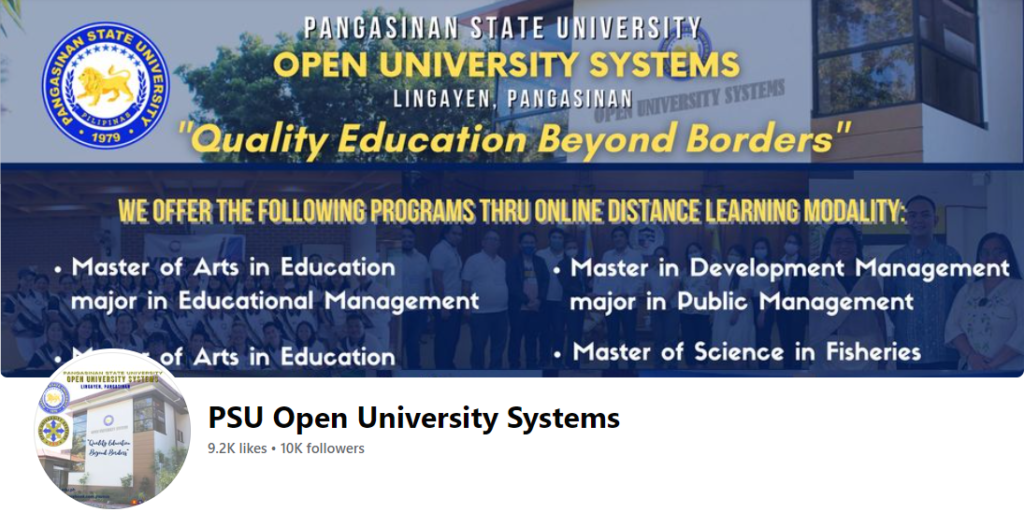
Pangasinan State University Open University Systems (PSU-OUS)
Pangasinan State University is one of the known universities outside Manila in the north with 8 strategically located campuses in the province. It is also one of the multi-awarded state universities in the whole country.
Besides the efficient implementation of the ETEEAP, it is also efficient in conducting and awarding graduate programs both on-campus and off-campus with their open university systems. To know more about them, you can visit their page with the image link below.
Philippine Christian University-Dasmariñas (PCU-Dasma)
Philippine Christian University-Dasmariñas is one of the campuses of PCU, a private university in the Philippines. This institution has produced quality students with their regular undergraduate programs and Bachelor of Science in Office Administration (BSOA) under their ETEEAP.
They also offer graduate degrees under their regular graduate programs which is open for Filipinos and foreign nationals.
Most state (and some private) universities offer Bachelor of Industrial Technology with the corresponding majors to the applicants’ skills under their ETEEAP. But what are these degree programs? Are they considered bachelors degree? And what are their equivalents?
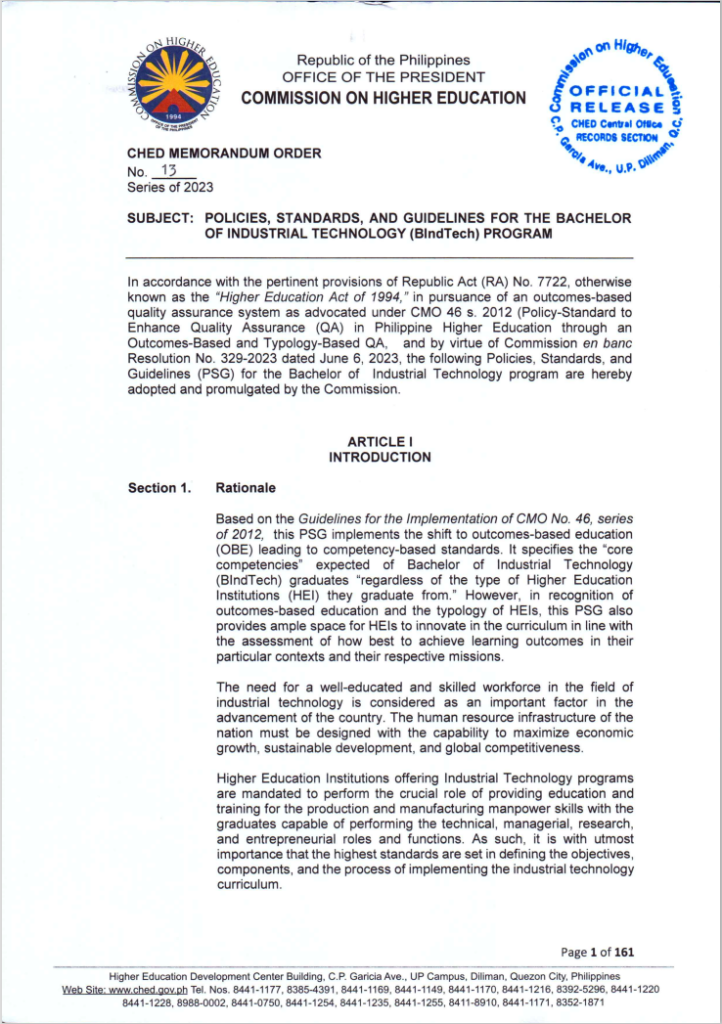
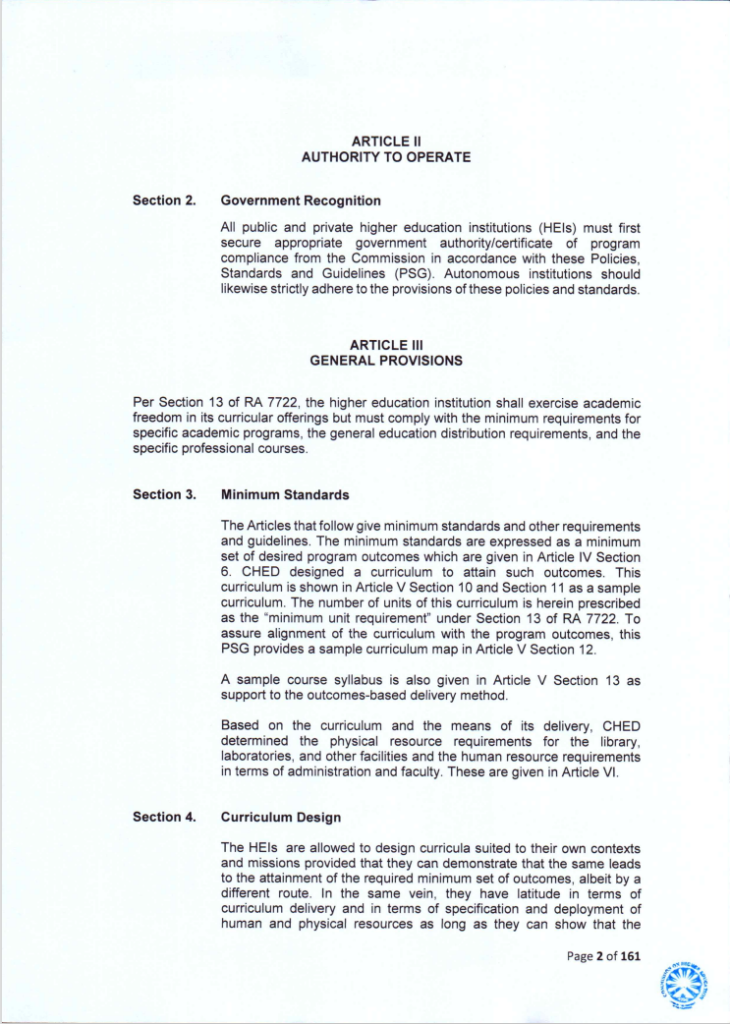
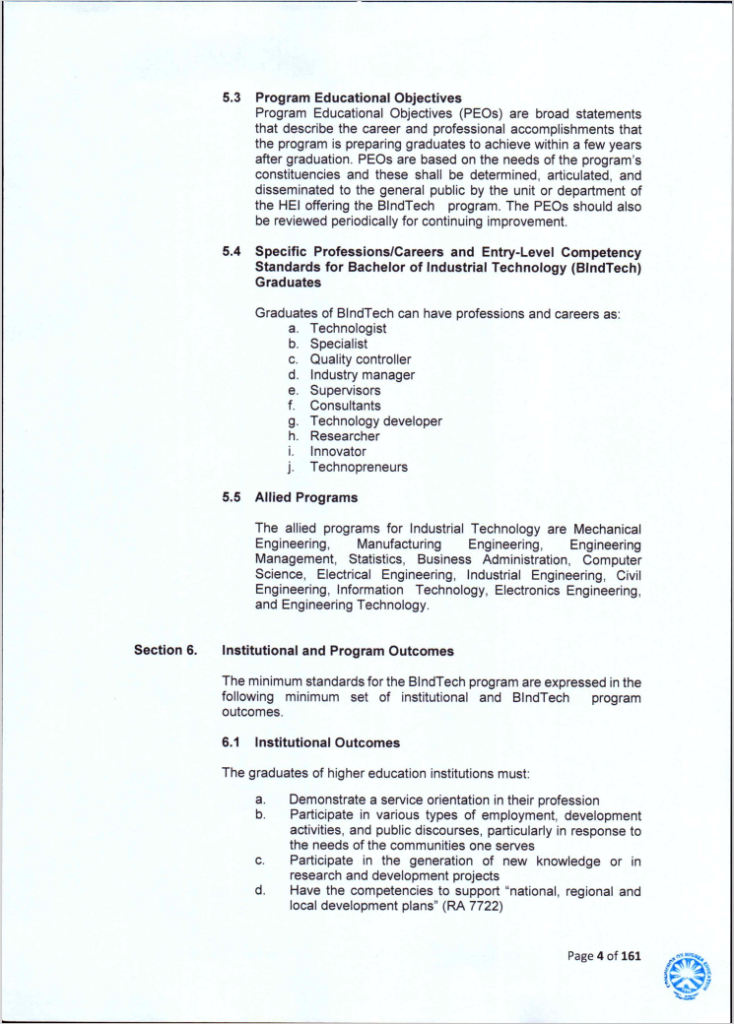
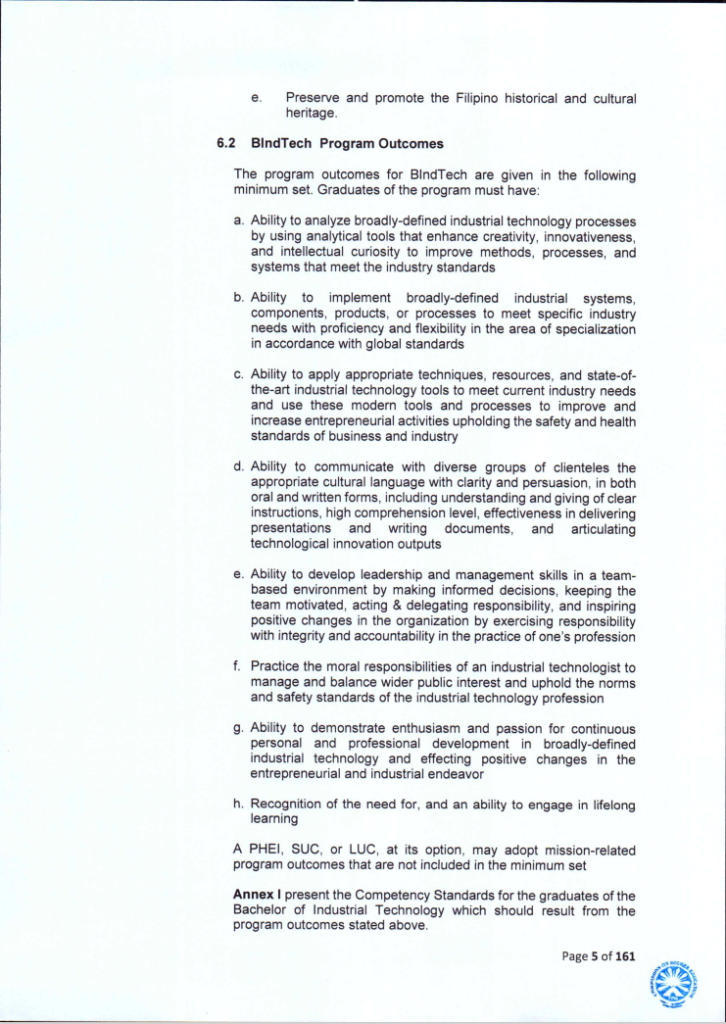
Let us take a closer look at this field. We will use the Commission on Higher Education Memorandum Order, which was signed and released on September 5, 2023 by CHED and called CMO-No-13-Series of 2023-BInd-Tech (CMO-13-S2023).
We only uploaded the image of the first 5 pages on this post as this is a 161-page document. If you want to see all the pages, you may click/tap on the links to either the CHED website or our resource page below. Documents from these links contain exactly the same information.
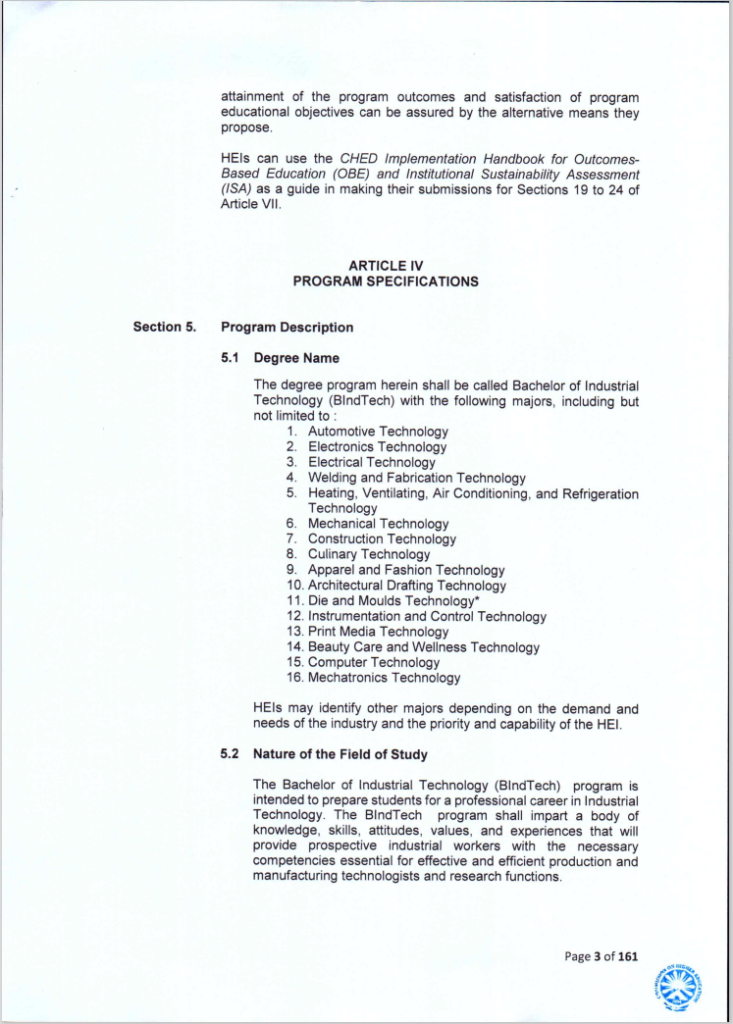
We don’t need to expound about this topic as the information on first 5 pages of the CMO on the following images are enough to explain what these programs are and their equivalent. Suffice to mention here the information found in the Article IV, Section 5.
Here is what it says:
ARTICLE IV PROGRAM SPECIFICATIONS
Section 5.Program Description
5.1 Degree Name The degree program herein shall be called Bachelor of Industrial Technology (BindTech) with the following majors, including but not limited to :
Automotive Technology
Electronics Technology
Electrical Technology
Welding and Fabrication Technology
Heating, Ventilating, Air Conditioning, and Refrigeration Technology
Mechanical Technology
Construction Technology
Culinary Technology
Apparel and Fashion Technology
Architectural Drafting Technology
Die and Moulds Technology
Instrumentation and Control Technology
Print Media Technology
Beauty Care and Wellness Technology
Computer Technology
Mechatronics Technology
HEls may identify other majors depending on the demand and needs of the industry and the priority and capability of the HEI.
5.2 Nature of the Field of Study The Bachelor of Industrial Technology (BindTech) program is intended to prepare students for a professional career in Industrial Technology. The BindTech program shall impart a body of knowledge, skills, attitudes, values, and experiences that will provide prospective industrial workers with the necessary competencies essential for effective and efficient production and manufacturing technologies, and research functions.
5.3 Program Educational Objectives Program Educational Objectives (PEOs) are broad statements that describe the career and professional accomplishments that the program is preparing graduates to achieve within a few years after graduation. PEOs are based on the needs of the program’s constituencies and these shall be determined, articulated, and disseminated to the general public by the unit or department of the HEI offering the BlndTech program. The PEOs should also be reviewed periodically for continuing improvement.
5.4 Specific Professions/Careers and Entry-Level Competency Standards for Bachelor of Industrial Technology (BlndTech) Graduates Graduates of BindTech can have professions and careers as:
Technologist
Specialist
Quality controller
Industry manager
Supervisors
Consultants
Technology developer
Researcher
Innovator
Technopreneurs
5.5 Allied Programs The allied programs for Industrial Technology are Mechanical Engineering, Manufacturing Engineering, Engineering Management, Statistics, Business Administration, Computer Engineering, Electrical Engineering, Industrial Engineering, Information Technology, Electronics Engineering and Engineering Technology.
Reference:CHED CMO No. 13, Series of 2023 – September 5, 2023
Schools that implement the program
One of the schools that is active in the above program is the Pangasinan State University. You may want to visit their page in the link below.
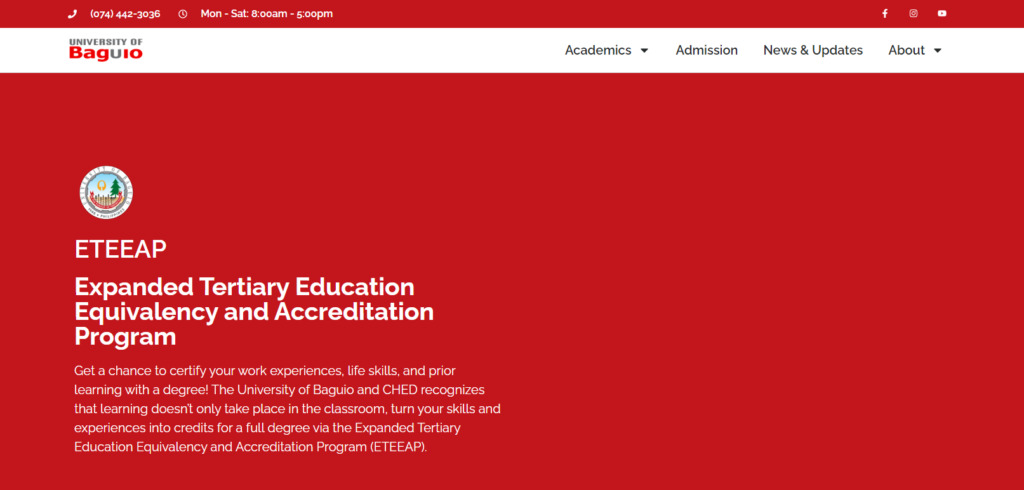
UB is one of the best private higher education institutions in the Cordillera Administrative Region (CAR). Their campus is located at the heart of the beautiful City of Baguio.
Included in their programs is the implementation of the Expanded Tertiary Education Equivalency and Accreditation Program(ETEEAP), being one of the hundreds of colleges and universities in the Philippines that were deputized by the Commission on Higher Education (CHED). They were also one of the pioneers in implementing the ETEEAP during the program’s infancy.
Programs Offered
The following are the programs they offer under the ETEEAP.
Bachelor of Science in Business Administration (BSBA) Bachelor of Science in Education (BSED) Bachelor of Science in Criminology (BS-Crim) Bachelor of Arts in Communications (BA-Comm) Bachelor of Arts in English (BA-Eng) Bachelor of Arts in Political Science (BA-PoliSci) Bachelor of Science in Civil Engineering (BSCE) Bachelor of Science in Computer Science (BSCS) Bachelor of Science in HRM (BS-HRM)
Some of their criminology graduates have upgraded their career in the PNP (as well as other related fields) and retired as generals, which goes along with their ads, “We produce leaders”.
Here are the links to their website and Facebook page so you can contact them directly.
See their programs in a nutshell on the following video.
PSU is one of the higher education institutions in Region 1 with 8 campuses within the province of Pangasinan.
Included in their programs is the implementation of the Expanded Tertiary Education Equivalency and Accreditation Program(ETEEAP), being one of the hundreds of colleges and universities in the Philippines that were deputized by the Commission on Higher Education (CHED). We are featuring the Asingan Campus on this site, although you can also enroll the same mentioned degree programs (and more) at their Lingayen Campus as well as three other campuses.
See the video testimony about PSU ETEEAP at the bottom of the page.
If you want to avail of the enrollment and documentation assistance for PSU, please click/tap on the link below.
The following are the programs that they offer under the ETEEAP. This page was made for the Asingan Campus, but there are also programs under the Lingayen and Bayambang campuses that were added to this page and these are properly specified below.
Bachelor of Secondary Education Majoring in:
Mathematics
Science
English
Filipino
Social Studies
Bachelor of Elementary Education
Bachelor of Technical and Livelihood Education-BTLE
Bachelor of Industrial Technology Majoring in:
Mechanical Technology – Welding – Plumbing – Electrical and Mechanical machines – Carpentry equipment – Mechanic – Gas piping system – Air conditioning system (HVAC) – Machining – Artillery – Weapons (firearms) – Factory machine operators
Automotive Technology – Automotive mechanics – Drivers with extensive background in troubleshooting and repair
Electronics Technology – Electronics – Computer technology – Communication systems – Semiconductor company workers
Drafting Technology (Lingayen Campus) – Draftsmen in the engineering field
PSU ETEEAPLearning Modality
PSU implements and delivers ETEEAP using the self-paced/self-guided Modular Learning System. Please see below the differences of the four learning systems used by different schools. You may also visit this link for the comprehensive discussion.
1) Face to face o inperson (F2F or IP) – Pupunta ang estudyante sa school at doon mismo mag-aral kasabay ng iba pang mga estudyante. Ito ay tinatawag na SYNCHRONOUS LEARNING.
2) Online – Hindi pupunta sa school ang estudyante ngunit mag-aaral din ito kasabay ng iba sa pamamagitan ng mga online learning tools tulad ng Zoom, Google Meet at Classroom, Messenger at iba pang virtual conference tools. SYNCHRONOUS LEARNING din ito.
3) Modular – Hindi pupunta sa school o sa online ang estudyante kundi matatanggap niya ang mga lesson niya sa door to door delivery, email o sa school portal at gagawin niya sa sariling schedule ang pag-aaral saka niya i-submit ang mga assignment niya sa pareho ding paraan ng pag-deliver sa kanya. Ito ay tinatawag na ASYNCHRONOUS LEARNING.
4) Hybrid – Ito ay anumang combination ng number 1, 2 at 3. Mayroong hybrid online-modular (HOM) at hybrid inperson-modular (HIM) o hybrid face-to-face and modular (HFM).
SYNCHRONOUS LEARNING – Sabay-sabay na mag-aral ang mga estudyante sa loob ng classroom o iba pang bahagi ng school campus, o sa pamamagitan ng mga virtual conference tools tulad ng Zoom, Google Meet, at Messenger.
ASYNCHRONOUS LEARNING – Hindi sabay-sabay ang pag-aaral at tatapusin ng estudyante ang mga assignment niya sa module na ipapadala sa kanya, sa pag log-in sa school portal o LMS, o sa Google Classroom ng school.
Preparation and Enrollment Assistance
If you are an OFW and need assistance in your preparation and enrollment, please visit the page in this link, or click/tap on the image link below.
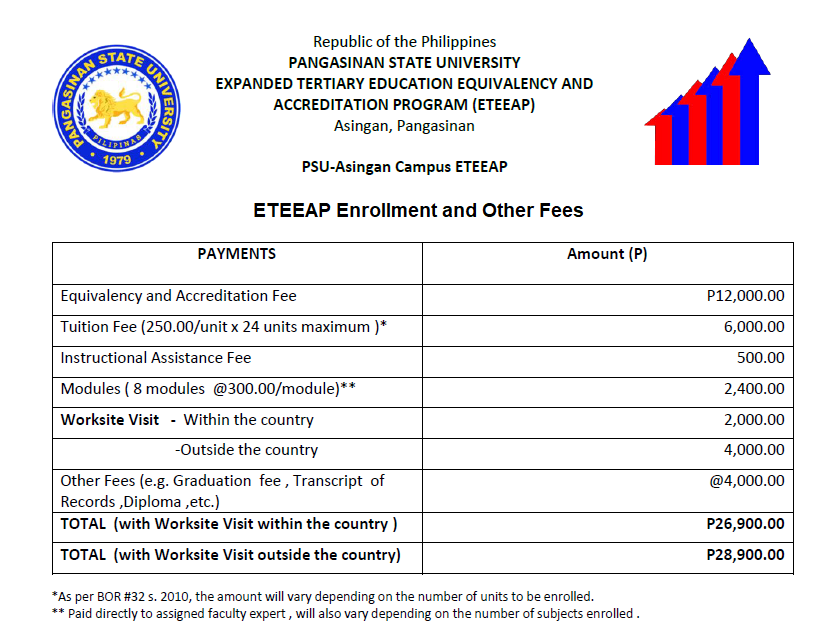
This is one of the first question prospective candidates always ask so we will explain it here. Below is the official fee schedule coming from their office. PSU’s fee structure is one of the cheapest in the Philippines as well as globally. Other questions and clarifications you may have in mind can be directly addressed to the authorized representative who cares for this project. You can find her contact details below.
Here is the list of requirements you need to prepare:
The list in the table below are categorized with the corresponding maximum score of each category. You need to meet the minimum score of 60.00 points to be able to enroll in PSU’s ETEEAP programs.
Credentials
Maximum Score
Required Forms: – Application letter (Letter of Intent) (Sample here – https://eteeap.org/appltr) – CV or resume (Sample here – https://eteeap.org/cv) – ETEEAP Application Form (Download here – https://eteeap.org/appform) – Birth certificate (Proof of your citizenship) – ID (Passport, Driver’s license, etc.) – For female applicants (Surname discrepancy proof – Marriage certificate, etc.)
0.00
Education Background: – High school documents (Diploma at form 137/138) – College degree certificate and OTR/TOR and confirmation letter – Other degree certificates and OTR/TOR and certificate/diploma – Vocational courses completed (TESDA, Technical Schools, etc.)
20.00
Work Experiences: – COE of all relevant employees (Sample here – https://eteeap.org/coe) – Recommendation/verification letter from employer (Link to Sample Recommendation Letter) – OFW documents/contracts/visa/employment certificates. – DFR of all relevant employees if details were not provided on the COE (Sample here – https://eteeap.org/dfr) Note: 1 year in addition to the minimum 5 years work (which earns 15 points + 1 point for each additional year) experience in the field you want to apply for ETEEAP earns one point.Maximum of 15 points for the excess years.
30.00
Inventions, Innovations, Publications: (Local, national, international) – Inventions (scope of acceptance, patronage and recognition) – Innovations (scope of acceptance, patronage and recognition) – Publications (scope of acceptance, patronage and recognition)
5.00
Informal Training Attended: – Informal training certificates (LinkedIn, Google, Microsoft, Udemy, TES, etc.) – Training/Seminar certificates provided or sponsored by your employer.
5.00
Training You Managed and Organized: (Local, national, international) – Training/Seminars that you organized, participated and/or conducted. – Resource speaker/lecturer
10.00
Awards, Commendations and Citations: (Local, national, international) – Awards at work (Best employee, leader or the month, etc.) – Citations or commendations by government agencies, NGOs, church, etc. – This should be after completing secondary education, or age 18 and older.
10.00
Community Services Rendered or Participated in: (Local, national, international) – Rescue, front liner, emergency assistance, calamity response, first response, etc. – Community outreach, relief assistance and other similar activities – Government-initiated, Voluntary, NGO, or Church organized
10.00
Club and Other Professional Organization Membership: (Local, national, international) – Lion’s Club, Rotary Club, Eagles, Toastmasters, Red Cross, OWWA, etc. – Profession-related professional group – TODA, JODA, Uber Drivers’ Association – Shooters’ Association – Athletes Association
10.00
Licenses and Eligibilities: (Local, national, international) – Driver’s license – PRC – Civil Service Eligibility – Gun license
Prepare a detailed resume or CV along with a cover letter of intent which includes the program of your interest.
Prepare a Detailed Functions and Responsibilities (DFR) or Service Record to be signed by your current employer. (See sample DFR in this link)
Prepare a Detailed Functions and Responsibilities (DFRs) or Service Records to be signed by your previous employers (If available).
Prepare copies of employment certificates (COE) of current and previous employers pertaining to number 3 and 4. (See sample COE in this link)
Request a recommendation letter from your employer. (See samples in this link)
Prepare all the other documents (NSO provided birth certificate, Diploma and transcripts of records of your completed education, etc).
Prepare all certificates of training, seminars and awards that you have acquired.
Prepare a list of your works or publications either in print or digital. (Examples: Websites, printed books you have written and published, newspaper or magazine articles you have written-online or in print; technical projects-patented or not such as electronic or electrical devices and equipment, big projects you were involved).
Any other relevant documents from any organization or entity as proof of your claimed skills and achievements.
Send the folder to PSU using one of the three options below:
Personally deliver the documents to PSU (Walk-in).
Ship the folder to PSU via DHL/FedEx/LBC/JRS/J&T/EMS or other forwarding companies.
Avail of the services provided by ETEEAP.org. You can see the procedure in the link below.
When you fill out your application form, please specify which offered program or degree you are interested to enroll in. After evaluation, the PSU ETEEAP administrators will send their reply to you informing you as to which of the courses/subjects and units/credits are covered by your credentials, and the subjects you still need to enroll along with the cost. ETEEAP enrollment is daily which means you will not follow a specific time frame. All subjects and requirements will be covered and completed through online learning modules.
Procedure of Document Submission for Evaluation
If you (especially OFWs) wish to avail of the enrollment and documentation assistance with PSU-Asingan, please click/tap on the link below. You may also click/tap on the image.
Important: Your documents should be printed and delivered or shipped to PSU for evaluation. The school no longer accepts online applications.
If you (especially OFWs) wish to avail of the enrollment and documentation assistance with PSU-Asingan, please click/tap the link below or on the image.
Individuals enrolled under the Program are required to have minimum residency of six (6) months. This means that even if your enrolled subjects are completed in less than 6 months, you can not apply for graduation, even if you have complied with all the requirements. Maximum residency is two years when and if you have not completed all your requirements, you need to undergo a re-evaluation and another enrollment procedure.
You will be provided additional instructions when your pre-evaluation is completed.
Important information and requirement after evaluation:
One of the requirements is for the college or university where you completed the units/credits that you submitted (if you did and where applicable) along with your other credentials to verify this by sending a copy of your Official Transcript of Record (OTR) directly to PSU, along with comments about your status.
For other details, you may directly inquire from the PSU-ETEEAP department though the contact person below.
________________________
Dr. Analyn I. Diola Focal Person, ETEEAP Pangasinan State University- Asingan Campus (PSU-Asingan) FVR Building Domanpot, Asingan, Pangasinan
Facebook: Aying Diola (Click or tap) Email: adiola.asingan@psu.edu.ph Click here to view or download the PSU FAQ document, although most of the information are already found on this page or in other parts of this site.
Updated Requirements and Submission Procedure
Requirements should be printed and in a long clear book (Email attachments or any other form of electronics/soft copies are not accepted, and you won’t be evaluated). The package should be sent to PSU for evaluation through any of the following procedures:
1) Personally deliver the documents to PSU (Walk-in). 2) Ship the folder to PSU via DHL/FedEx/LBC/JRS/J&T/EMS or other forwarding companies. 3) Avail of the services provided by ETEEAP.org. You can see the procedure in the link below.
If you wish to avail of the enrollment and documentation assistance with PSU-Asingan, please click/tap on the image link below.
You may have skills that you acquired from your years of experiences in your workplace but you cannot produce certificates to prove such except for the recommendations and employment certificates provided by your employer. Many HEIs are requiring skill-specified certificates that were earned from learning institutions and training centers and most of them accept those that were taken up online.
We have a few suggestions here that may help you. These are already established online learning sites and some of their learning modules are used by some universities and colleges as part of their learning resources.
Create an account with LinkedInhere and complete your profile. Then visit their learning siteshere where you can find their free lessons and take up an examination at the end of each lesson. You can then download the certificates that you can use as credentials.
They have one month free trial on premium accounts that you may want to take advantage of where you can find premium lessons. You may continue with the paid premium account at the end of the trial period if you wish.
Google also offers online lessons in different topics. They have free lessons but if you want to earn a certificate, you need to pay a certain amount for each examination that you take up. You may visit their learning site here.
The Philippine government has set up a department that provides free training on different skills where one can earn a certificate at the end. You may visit their website here, and their e-learning site here.
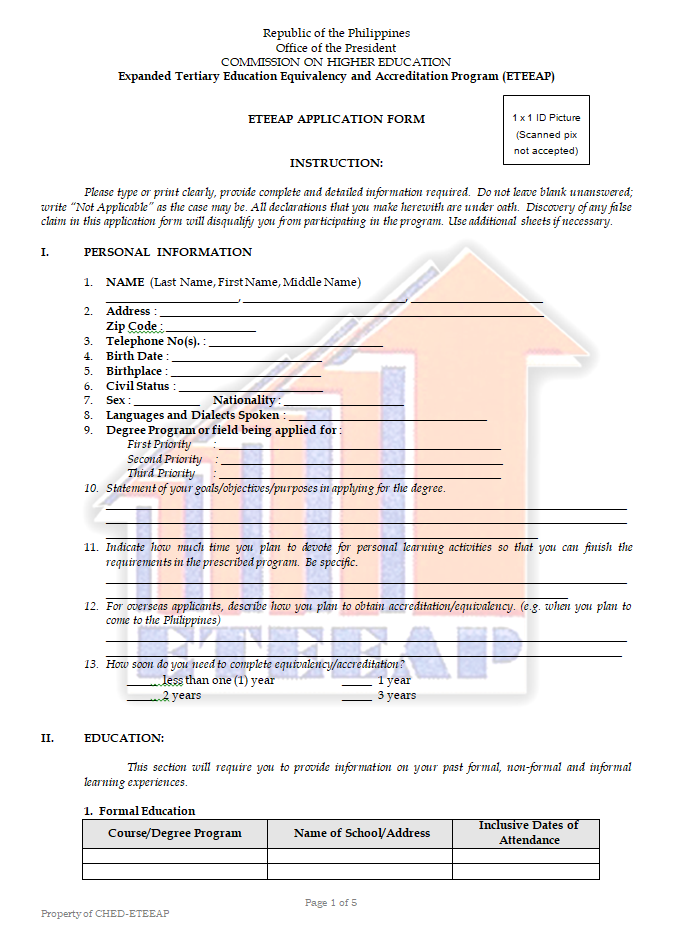
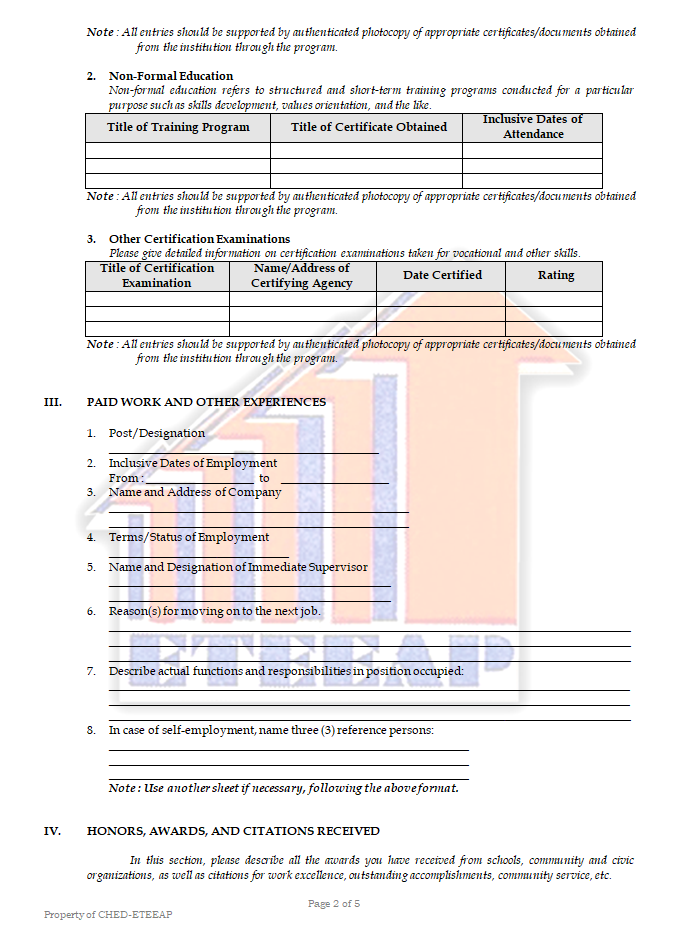
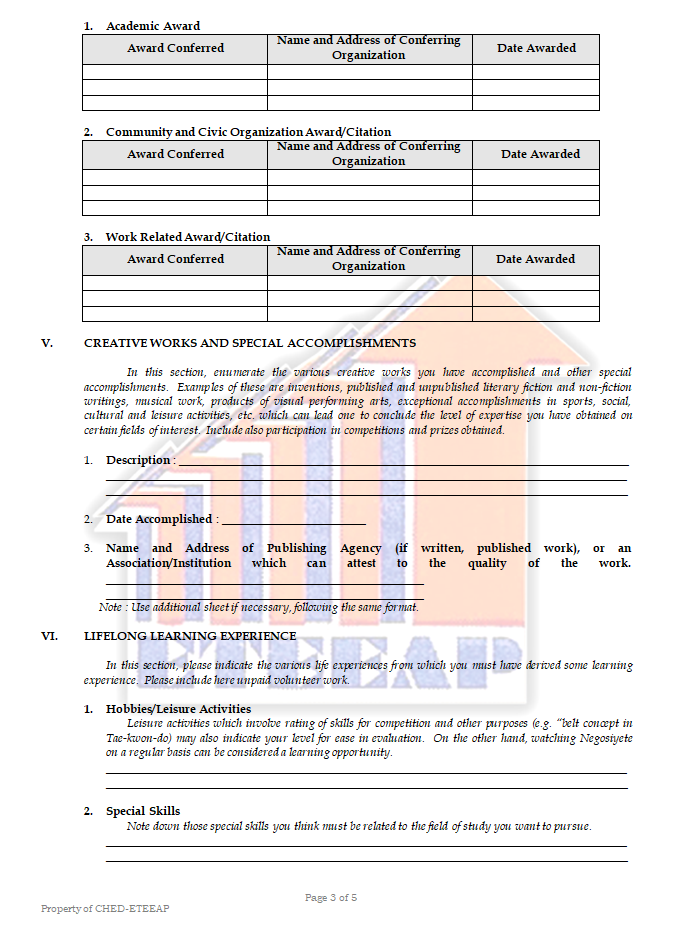
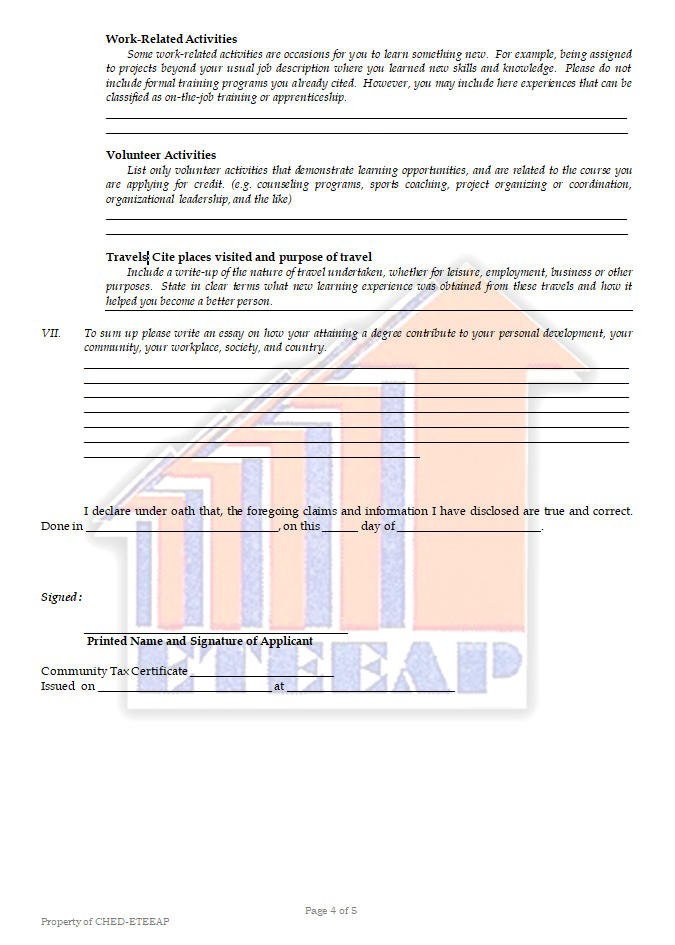
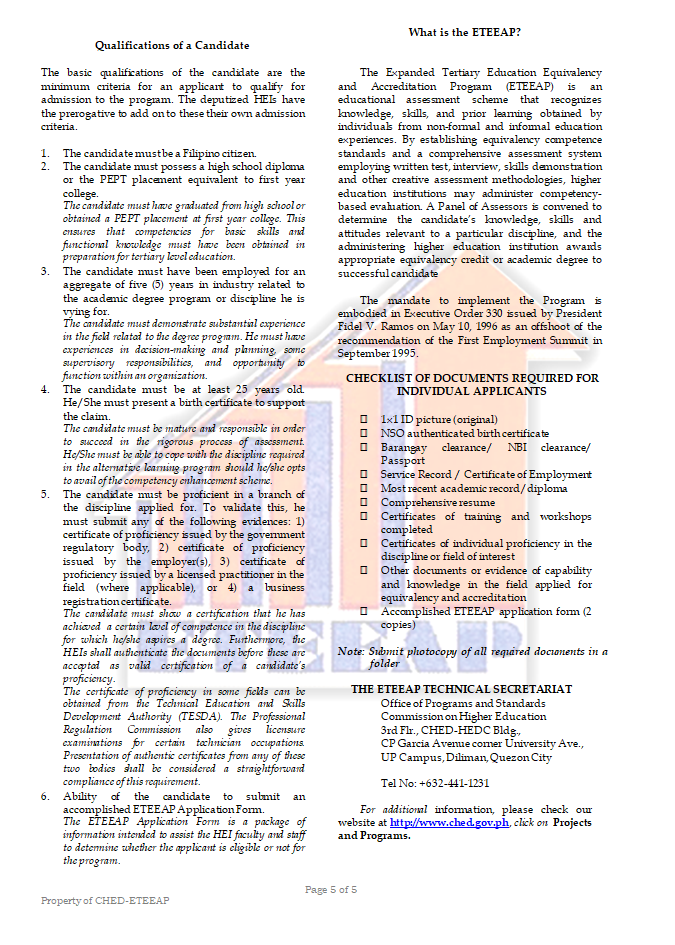
This page contains the application form that need to be completed and submitted to the school where you want to enroll (NOT to CHED). For those who need to prepare other required documents for their ETEEAP application, we have links to the samples at the bottom of the page, below the images. You may visit the pages where these documents were described in details along with their downloadable and editable versions.
As for the application form, the editable version on Microsoft word can be downloaded here, or on the the link located below the image number 5.
Important:Please check your download folder after you click on the download link.