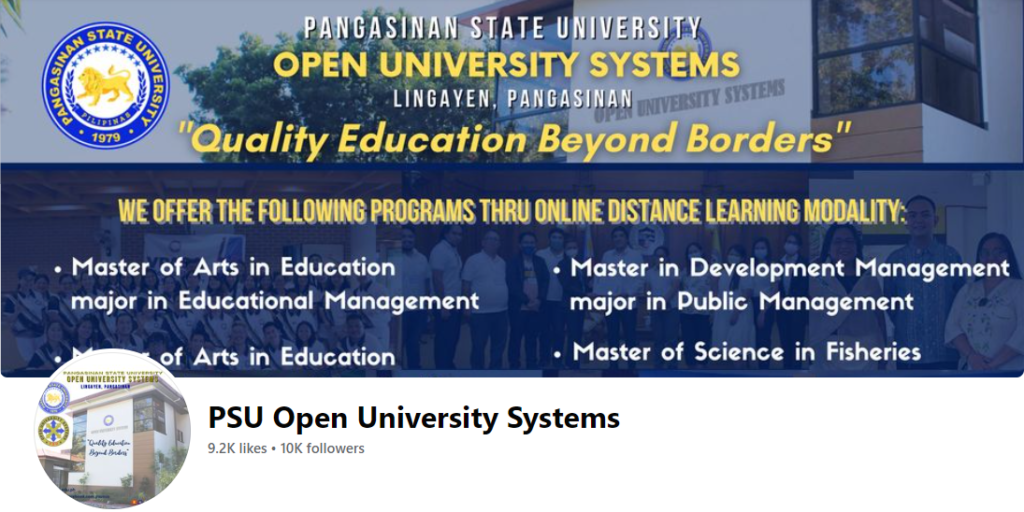
Pangasinan State University Open University Systems (PSU-OUS)
Pangasinan State University is one of the known universities outside Manila in the north with 8 strategically located campuses in the province. It is also one of the multi-awarded state universities in the whole country.
Besides the efficient implementation of the ETEEAP, it is also efficient in conducting and awarding graduate programs both on-campus and off-campus with their open university systems. To know more about them, you can visit their page with the image link below.
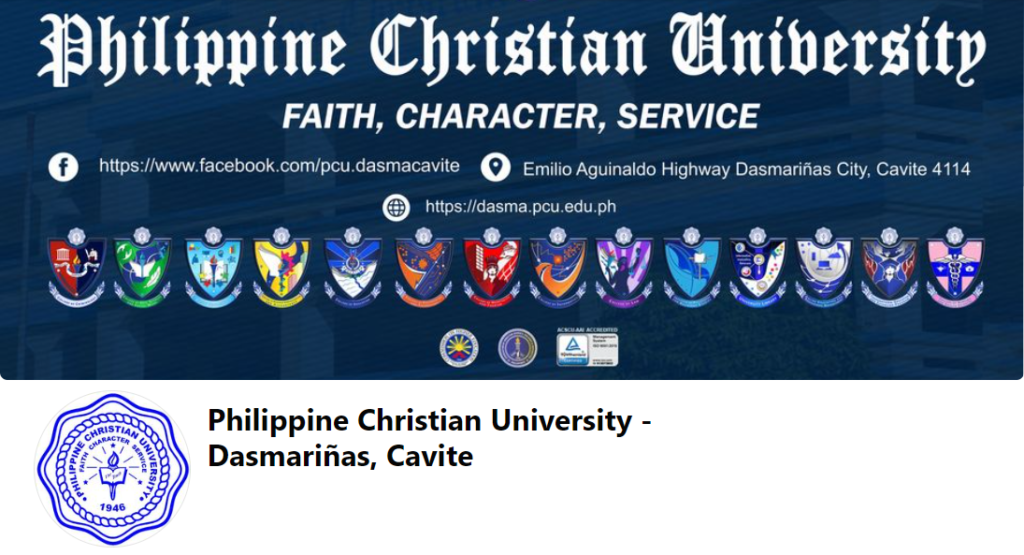
Philippine Christian University-Dasmariñas (PCU-Dasma)
Philippine Christian University-Dasmariñas is one of the campuses of PCU, a private university in the Philippines. This institution has produced quality students with their regular undergraduate programs and Bachelor of Science in Office Administration (BSOA) under their ETEEAP.
They also offer graduate degrees under their regular graduate programs which is open for Filipinos and foreign nationals.
Most state (and some private) universities offer Bachelor of Industrial Technology with the corresponding majors to the applicants’ skills under their ETEEAP. But what are these degree programs? Are they considered bachelors degree? And what are their equivalents?
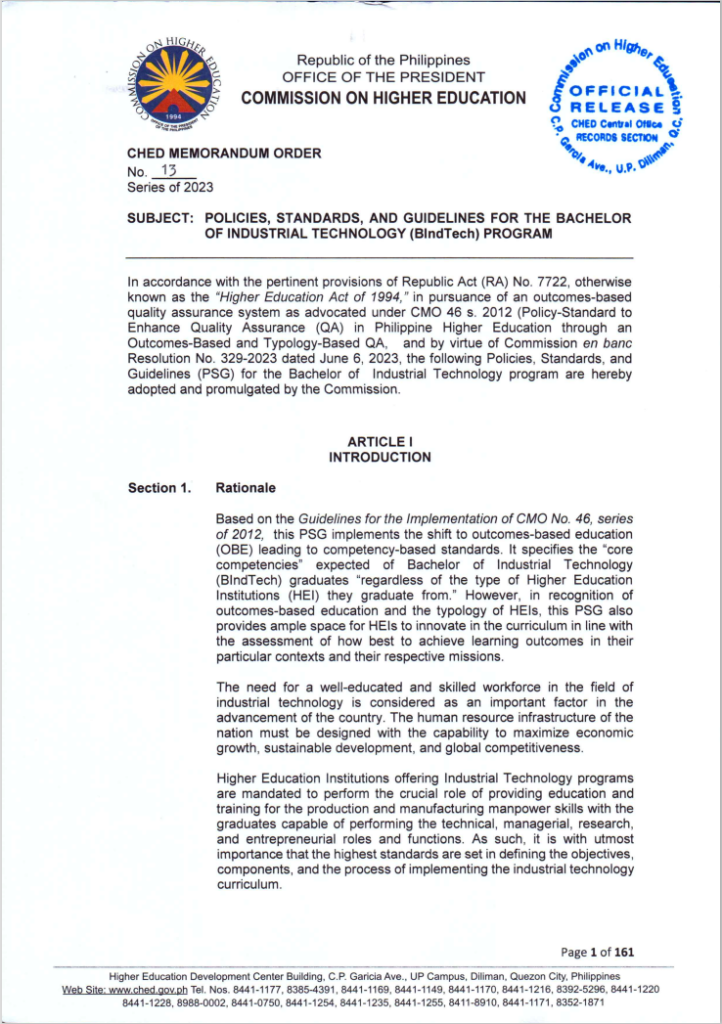
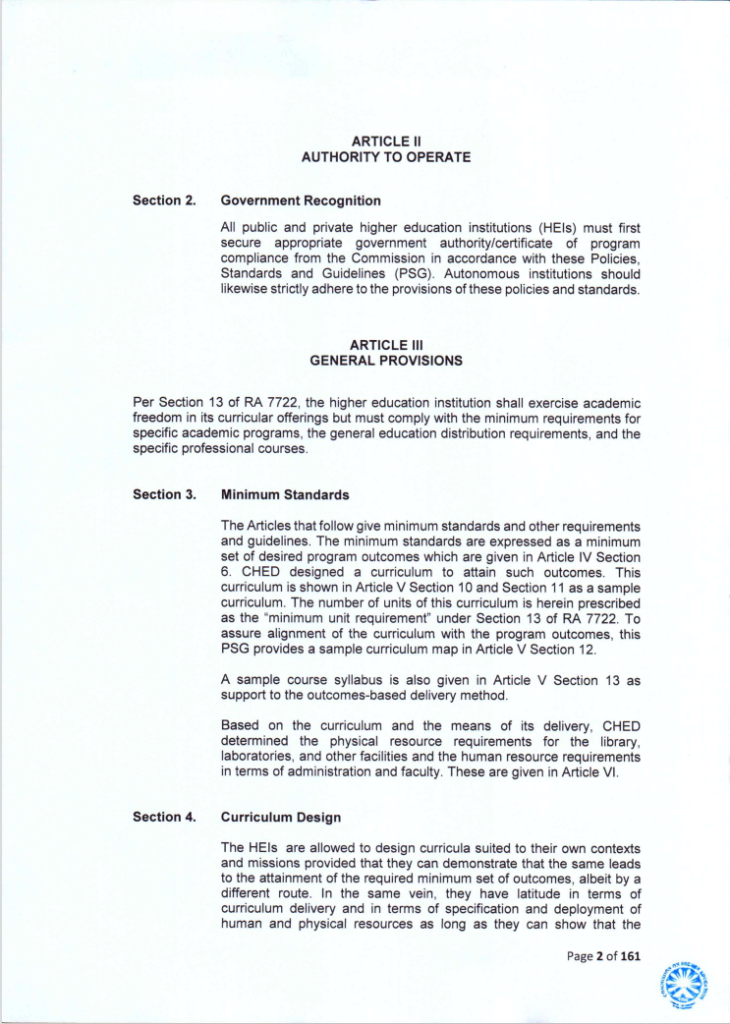
Let us take a closer look at this field. We will use the Commission on Higher Education Memorandum Order, which was signed and released on September 5, 2023 by CHED and called CMO-No-13-Series of 2023-BInd-Tech (CMO-13-S2023).
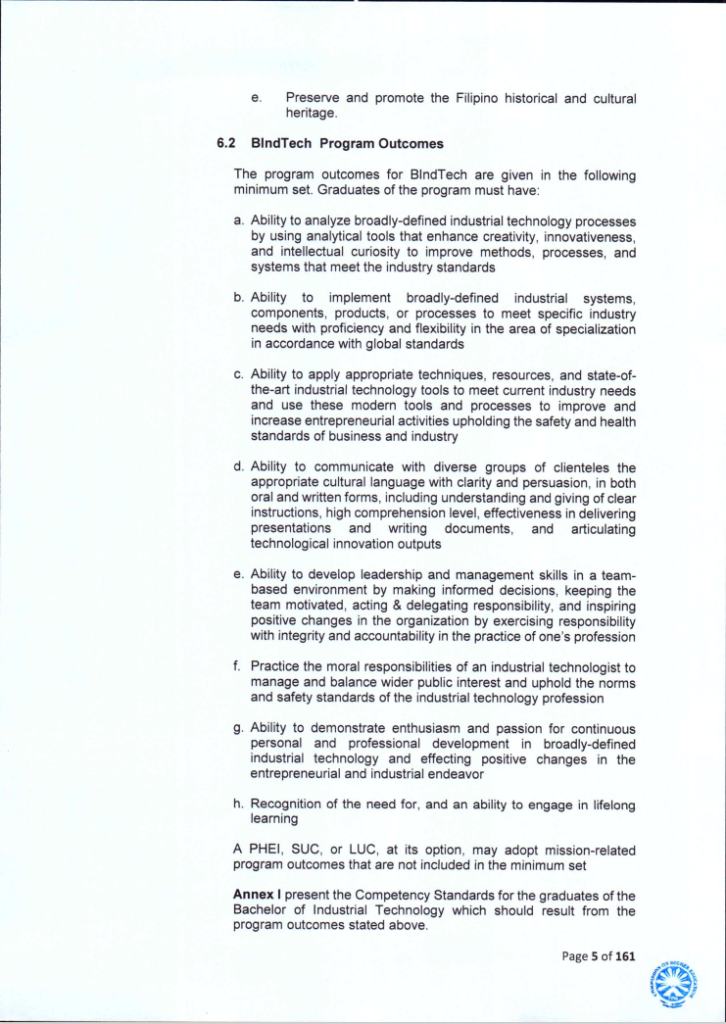
We only uploaded the image of the first 5 pages on this post as this is a 161-page document. If you want to see all the pages, you may click/tap on the links to either the CHED website or our resource page below. Documents from these links contain exactly the same information.
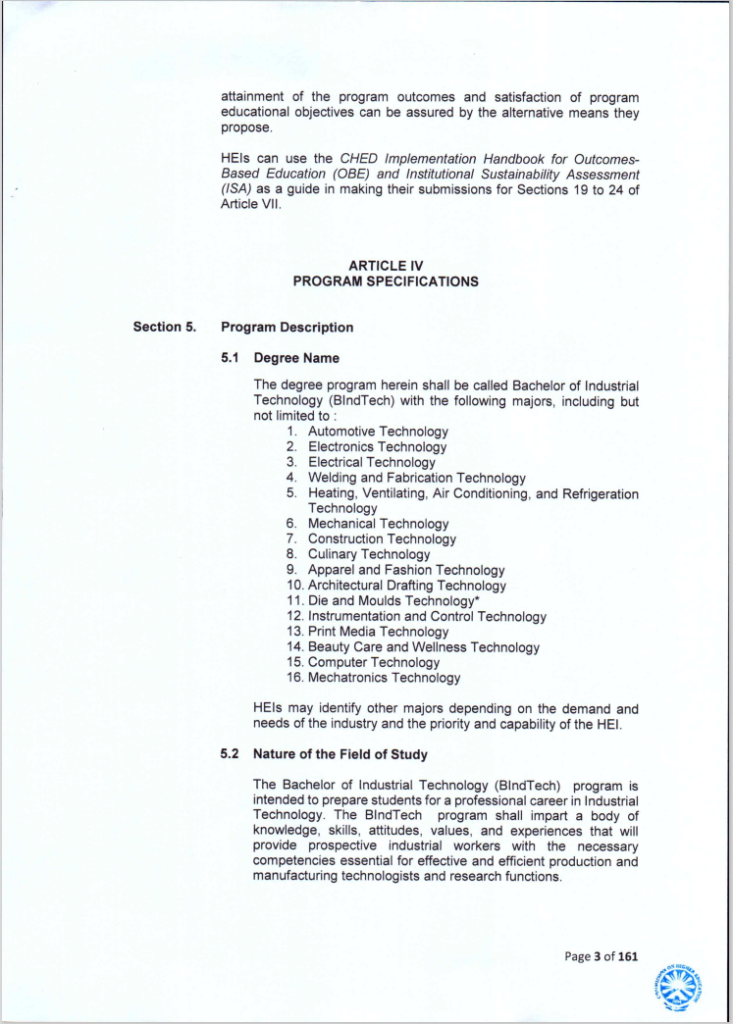
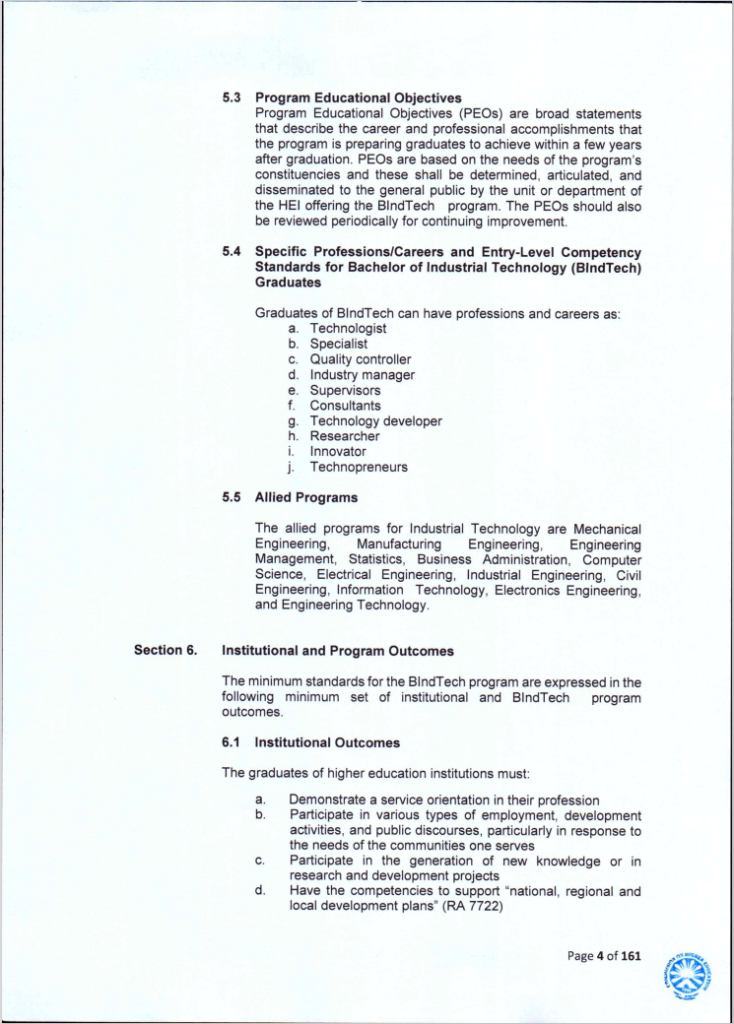
We don’t need to expound about this topic as the information on first 5 pages of the CMO on the following images are enough to explain what these programs are and their equivalent. Suffice to mention here the information found in the Article IV, Section 5.
Here is what it says:
ARTICLE IV PROGRAM SPECIFICATIONS
Section 5.Program Description
5.1 Degree Name The degree program herein shall be called Bachelor of Industrial Technology (BindTech) with the following majors, including but not limited to :
Automotive Technology
Electronics Technology
Electrical Technology
Welding and Fabrication Technology
Heating, Ventilating, Air Conditioning, and Refrigeration Technology
Mechanical Technology
Construction Technology
Culinary Technology
Apparel and Fashion Technology
Architectural Drafting Technology
Die and Moulds Technology
Instrumentation and Control Technology
Print Media Technology
Beauty Care and Wellness Technology
Computer Technology
Mechatronics Technology
HEls may identify other majors depending on the demand and needs of the industry and the priority and capability of the HEI. This means HEIs can come up with other nomenclatures for their programs as well as creating other, or combining different specializations into specific, majors.
5.2 Nature of the Field of Study The Bachelor of Industrial Technology (BindTech) program is intended to prepare students for a professional career in Industrial Technology. The BindTech program shall impart a body of knowledge, skills, attitudes, values, and experiences that will provide prospective industrial workers with the necessary competencies essential for effective and efficient production and manufacturing technologies, and research functions.
5.3 Program Educational Objectives Program Educational Objectives (PEOs) are broad statements that describe the career and professional accomplishments that the program is preparing graduates to achieve within a few years after graduation. PEOs are based on the needs of the program’s constituencies and these shall be determined, articulated, and disseminated to the general public by the unit or department of the HEI offering the BlndTech program. The PEOs should also be reviewed periodically for continuing improvement.
5.4 Specific Professions/Careers and Entry-Level Competency Standards for Bachelor of Industrial Technology (BlndTech) Graduates Graduates of BindTech can have professions and careers as:
Technologist
Specialist
Quality controller
Industry manager
Supervisors
Consultants
Technology developer
Researcher
Innovator
Technopreneurs
5.5 Allied Programs The allied programs for Industrial Technology are Mechanical Engineering, Manufacturing Engineering, Engineering Management, Statistics, Business Administration, Computer Engineering, Electrical Engineering, Industrial Engineering, Information Technology, Electronics Engineering and Engineering Technology.
Reference:CHED CMO No. 13, Series of 2023 – September 5, 2023
Schools that implement the program
One of the schools that is active in the above program is the Pangasinan State University. You may want to visit their page in the link below.
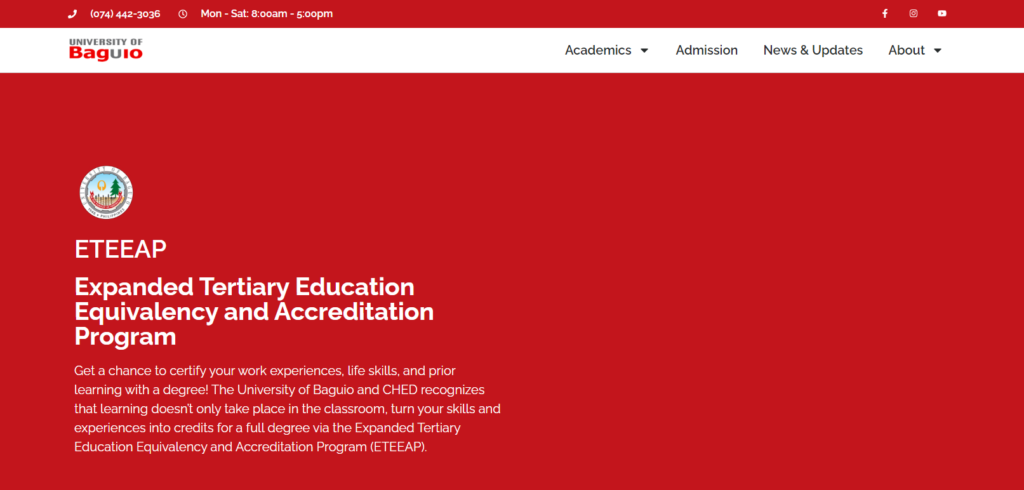
University of Baguio is known among the private higher education institutions in the Cordillera Administrative Region (CAR) as well as one of best in the whole country. Their campus is located at the heart of the beautiful City of Baguio which is another reason why it is one of the best choices when it comes to tertiary education.
Included in their programs is the implementation of the Expanded Tertiary Education Equivalency and Accreditation Program(ETEEAP). They are one of the hundreds of colleges and universities in the Philippines that were deputized by the Commission on Higher Education (CHED) to implement the said program. They were also one of the pioneers in implementing the ETEEAP during the program’s infancy.
Offered Programs Under ETEEAP (2026)
The following are the programs they offer under the ETEEAP.
Bachelor of Science in Tourism Management
Bachelor of Science in Information Technology
Bachelor of Science in Criminology
Bachelor of Arts in English
Bachelor of Science in Computer Science
Bachelor of Arts in Communication
Bachelor of Arts in Political Science
Bachelor in Elementary Education
Bachelor in Secondary Education
English
Math
Social Studies
Filipino
Bachelor of Science in Business Administration
Financial Management
Operations Management
Marketing Management
Human Resource Management
Bachelor of Science in Hospitality Management
Professional Culinary Arts
Int. Hotel and Business Operations
Specializations and Notable Credentials
UB is known for its specialization in Business Administration & Accountancy, Criminal Justice & Public Safety, Dentistry, Engineering & Architecture, Information Technology, International Hospitality & Tourism Management, Law, Natural Sciences, Nursing, Teacher Education and Liberal Arts.
Some of their criminology graduates have upgraded their career in the PNP (as well as other related fields) and retired as generals, which goes along with one of their ads and taglines, “We produce leaders“.
Here are the links to their website and Facebook page so you can contact them directly.
See their programs in a nutshell on the following video.
There are two ways to prepare your requirements and apply for enrollment.
First Option: The Do-It-Yourself (DIY) with the help of the procedures and preparation guides found on the school’s page in the link below. We also have all the information you need on this website to prepare in your ETEEAP journey, and all for free. You are free to explore this site for the information you need.
Second Option: However, if you have difficulty with some of the needed steps in the DIY option and still need help or guidance in your preparation, we also provide such with a minimal fee. Please see the Application Facilitator Assistance below.
Application Facilitator Assistance
If after searching for the free information on this site and you still find that you struggle in your preparation and you need someone to represent you, or facilitate your application in your behalf, we here at ETEEAP.ORG and HYBLEXSOL also offer paid assistance for a minimal fee. This is especially so if you are an OFW or live far from Baguio. If you do need such services, please visit the link below or click/tap on the image that takes you to the page.
PSU is one of the higher education institutions in Region 1 with 8 campuses within the province of Pangasinan. They continuously coordinate with different government agencies and private companies to provide solutions to employees who need to upgrade their academic requirements for job stability and new opportunities, which is in agreement with their new motto, “We Create Possibilities“.
Included in their programs is the implementation of the Expanded Tertiary Education Equivalency and Accreditation Program(ETEEAP), being one of the hundreds of colleges and universities in the Philippines that were deputized by the Commission on Higher Education (CHED). We are featuring the Asingan Campus on this site, although you can also enroll the same mentioned degree programs (and more) at their Lingayen Campus as well as three other campuses.
See the video testimony about PSU ETEEAP at the bottom of the page.
If you want to avail of the enrollment and documentation assistance for PSU, please click/tap on the link below.
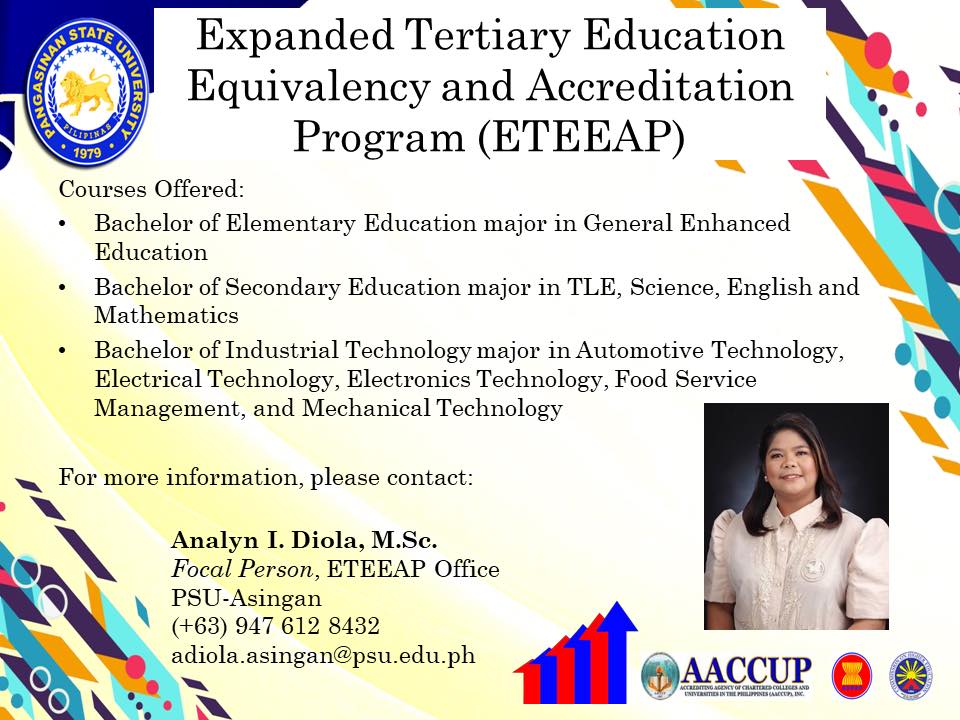
The following are the programs that they offer under the ETEEAP. This page was made for the Asingan Campus, but there are also programs under the Lingayen and Sta. Maria campuses that were added to this page and these are properly specified below.
Under the Bachelor of Industrial Technology (BIT)
(For more detailed discussion about Bachelor of Industrial Technology, you may visit this link.)
Majoring in:
Mechanical Technology Qualified or aligned work experiences:
Welding
Plumbing
Electrical and Mechanical machines
Carpentry equipment
Mechanic
Gas piping system
Air conditioning system (HVAC)
Machining
Artillery
Weapons (firearms)
Factory machine operators
Heavy equipment operators
Farm equipment operators
Janitorial and building maintenance equipment operators
Automotive Technology Qualified or aligned work experiences:
Automotive and machine mechanics
Bus and truck drivers
Delivery riders
Heavy equipment operators
Farm equipment operators
Electronics Technology Qualified or aligned work experiences:
Electronics
Computer technology
Communication systems
Semiconductor company workers
Office machine operators
TELCO
Electrical Technology Qualified or aligned work experiences:
Electricians
Electrical technicians
Automotive electricians
Linemen
Power plant maintenance
Shipping electricians
Food Service Management Qualified or aligned work experiences:
Restaurants
Resort food courts
Canteens
Fast food establishments
Food preparation
Catering services employees and owners
DH and Caregivers
Garments and Fashion Design (Lingayen Campus) Qualified or aligned work experiences:
Garments factory workers
Tailoring/sewing shop owners
Sales of garments and apparels
Drafting Technology (Lingayen Campus) Qualified or aligned work experiences:
Draftsmen in the engineering field
The following are non-circumventable requirements to qualify into the above-mentioned BIT programs. If you do not posses any of the following, we will not evaluate your application and will not reply to you.
5 years or longer experience under the above-mentioned programs under a single employer.
5 years or longer experience under the above-mentioned programs under different employers in different time frames (Aggregate).
5 years or longer experience under the above-mentioned programs under different/multiple non-overlapping employers (Aggregate).
Under the College of Education
Bachelor of Secondary Education (BSE) Majoring in: – Mathematics (BSE-Math) – Science (BSE-Sci) – English (BSE-Eng) – Filipino (BSE-Fil) – Social Studies (BSE-SS) Bachelor of Elementary Education (BEED) Bachelor of Technical and Livelihood Education (BTLE)
The following are non-circumventable requirements to qualify into the education programs. If you do not posses any of the following, we will not evaluate your application and will not reply to you.
5 years or longer experience in teaching at a regular school.
5 years or longer experience in teaching in blended settings (face to face and online).
5 years or longer experience as assistant/shadow/back up teacher
Worked in different teaching position at regular schools under different/multiple non-overlapping employers (Aggregate).
Other teaching positions
Please note that DH, caregivers and nanny-tutors DO NOT QUALIFY in the education programs even if they have unfinished education degree before working as such. If a full-time mother who tutored her 5 children from kindergarten to college for more than 20 years does not qualify, it is more so with a hired nanny-tutor of one or two children. They may qualify for the BIT-FSM instead.
BPO employees who have the position as trainers are NOT qualified in the education program. They may take up other appropriate programs aligned with their specialization, then take up a teacher certification after.
Under the College of Agriculture
Bachelor of Science in Agriculture (Sta. Maria Campus)
PSU ETEEAPLearning Modality
PSU implements and delivers ETEEAP using the self-paced/self-guided Modular Learning System. Please see below the differences of the four learning systems used by different schools. You may also visit this link for the comprehensive discussion.
1) Face to face o inperson (F2F or IP) – Pupunta ang estudyante sa school at doon mismo mag-aral kasabay ng iba pang mga estudyante. Ito ay tinatawag na SYNCHRONOUS LEARNING.
2) Online – Hindi pupunta sa school ang estudyante ngunit mag-aaral din ito kasabay ng iba sa pamamagitan ng mga online learning tools tulad ng Zoom, Google Meet at Classroom, Messenger at iba pang virtual conference tools. SYNCHRONOUS LEARNING din ito.
3) Modular – Hindi pupunta sa school o sa online ang estudyante kundi matatanggap niya ang mga lesson niya sa door to door delivery, email o sa school portal at gagawin niya sa sariling schedule ang pag-aaral saka niya i-submit ang mga assignment niya sa pareho ding paraan ng pag-deliver sa kanya. Ito ay tinatawag na ASYNCHRONOUS LEARNING.
4) Hybrid – Ito ay anumang combination ng number 1, 2 at 3. Mayroong hybrid online-modular (HOM) at hybrid inperson-modular (HIM) o hybrid face-to-face and modular (HFM).
SYNCHRONOUS LEARNING – Sabay-sabay na mag-aral ang mga estudyante sa loob ng classroom o iba pang bahagi ng school campus, o sa pamamagitan ng mga virtual conference tools tulad ng Zoom, Google Meet, at Messenger.
ASYNCHRONOUS LEARNING – Hindi sabay-sabay ang pag-aaral at tatapusin ng estudyante ang mga assignment niya sa module na ipapadala sa kanya, sa pag log-in sa school portal o LMS, o sa Google Classroom ng school.
How to Apply
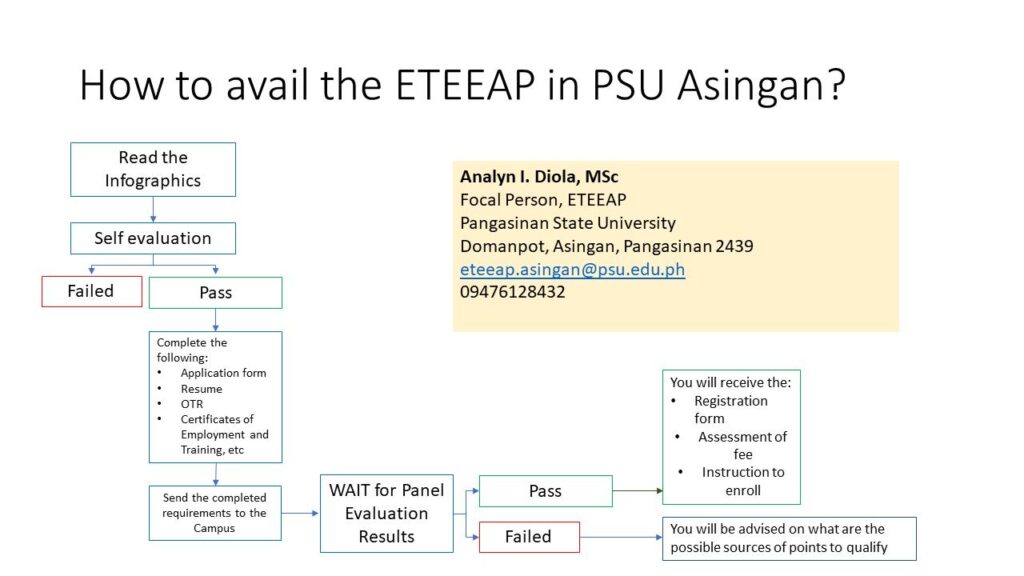
For applicants, please read the following important instructions and procedures, along with the proper way of submitting your application for evaluation.
All required documents should be printed, organized and bound into a folder (long, clear book) for the school to evaluate the applicant’s credentials. The school does not evaluate, and not reply to, applications sent through email or to the focal person’s messenger. Kailangang naka-print at nasa long clear book ang lahat ng mga credential ng aplikante para ma-evaluate. Hindi ini-evaluate ang sinend lang sa email o sa messenger ng focal person, at hindi din sila magre-reply dito.
Incomplete requirements will not be evaluated, even if printed and properly bound. It is automatically failed. Hindi ini-evaluate ang hindi kompletong requirement kahit pa naka-print ito at nasa maayos na folder. Automatic na failed yan.
Applicants should not send just a CV and a few documents from the list of requirements just to know if they are eligible to enroll into the program, and if it’s worth preparing the rest of the requirements (especially if just sent through emailor to the focal person’s messenger). In the first place, all ETEEAP schools require the same set of major requirements along with other minor requirements and sent through the proper channel and procedure. Hindi ka magse-send ng CV lang at ilang document sa listahan ng mga requirement para lang malaman kung eligible ka sa program, o worth ba na ituloy na ipunin ang mga requirement (lalo na kung ise-send mo lang sa email o sa messenger ng focal person). Unang-una, lahat ng school ay dapat kompleto ang requirement para pumasa at halos lahat ay pare-pareho ang mga major requirement, at saka idagdag ang mga minor requirement.
How do I know if I really qualify even before submitting my requirements? You need to do a proper and realistic self-evaluation keeping your DREAM DEGREE (or the degree you want) out of your mind and focus on what ETEEAP really is. Paano mo malalaman kung eligible ka? Proper self-evaluation at habang ginagawa mo yan, alisin mo sa isip mo ang DREAM DEGREE mo (o yung gusto mong degree) at mag-focus ka sa kung ano ang sistema at requirement ng ETEEAP.
Special Arrangement for OFW’s
If you are an OFW and need assistance in your preparation and for the facilitation of your application, you may want to visit the page in the link (image link) below for an optional third party services.
PaidPreparation Facilitator (Optional Third Party)
If you are an OFW, or even in the Philippines, and need paid assistance in your preparation and enrollment, please visit the page in this link, or click/tap on the image link below.
Disclaimer: These services are not connected to PSU. It is provided by the administrators of this information website if you need a legitimate assistance that delivers.
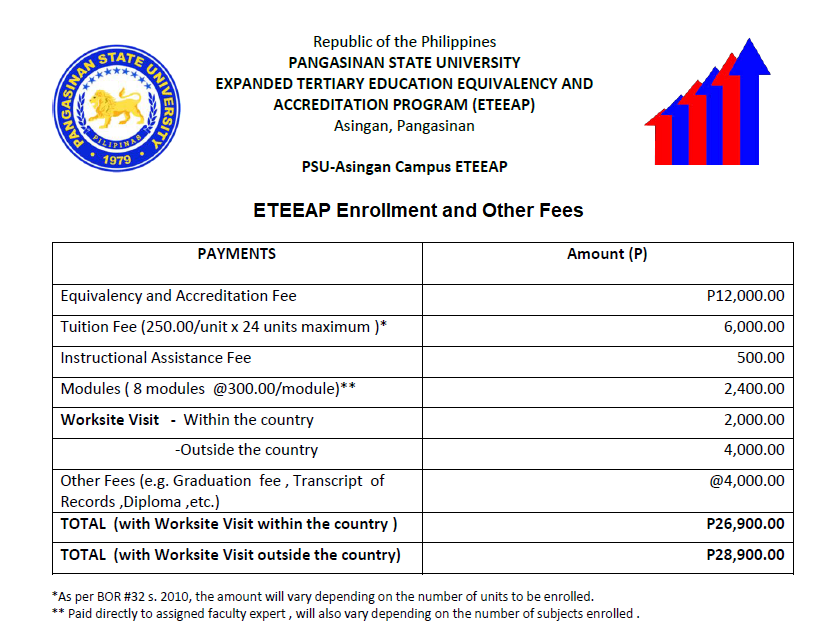
This is one of the first question prospective candidates always ask so we will explain it here. Below is the official fee schedule coming from their office. PSU’s fee structure is one of the cheapest in the Philippines as well as globally. Other questions and clarifications you may have in mind can be directly addressed to the authorized representative who cares for this project. You can find her contact details below.
PaidPreparation Facilitator (Optional Third Party)
For OFW’s and other individuals or groups who cannot apply on campus and need assistance and consultancy in their preparation for evaluation and enrollment, there is a special reasonably-priced paid assistance arrangement made for you. Including the above-mentioned fees, your total expense does not exceed PHP40,000.00 until completion or graduation.
You can see the complete information in the link below (Or tap on the image to go the the page).
Prepare a detailed resume or CV along with a cover letter of intent which includes the program of your interest.
Prepare a Detailed Functions and Responsibilities (DFR) or Service Record to be signed by your current employer. (See sample DFR in this link)
Prepare a Detailed Functions and Responsibilities (DFRs) or Service Records to be signed by your previous employers (If available).
Prepare copies of employment certificates (COE) of current and previous employers pertaining to number 3 and 4. (See sample COE in this link)
Request a recommendation letter from your employer. (See samples in this link)
Prepare all the other documents (NSO provided birth certificate, Diploma and transcripts of records of your completed education, etc).
Prepare all certificates of training, seminars and awards that you have acquired.
Prepare your community service certificates. These could be proofs of activities similar to NSTP that were were involved with after you reached the age of 18 while you were already working (Not part of your secondary education or first year college requirements).
Prepare proof of professional group or organization membership. For OFW’s the OWWA membership is one along with other membership you have in connection with your profession (educators, electricians, drivers, seafarers, TODA, cooperative, NGO, government organization and other similar).
Prepare a list of your works or publications either in print or digital. (Examples: Websites, printed books you have written and published, newspaper or magazine articles you have written-online or in print; technical projects-patented or not such as electronic or electrical devices and equipment, big projects you were involved).
Any other relevant documents from any organization or entity as proof of your claimed skills and achievements. These could be compulsory trainings sponsored by your company, trainings you voluntarily attended or activities where your skills were demonstrated.
Send the folder to PSU using one of the three options below:
Personally deliver the documents to PSU (Walk-in).
Ship the folder to PSU via DHL/FedEx/LBC/JRS/J&T/EMS or other forwarding companies.
Avail of the services provided by ETEEAP.org. You can see the procedure in the link below.
When you fill out your application form, please specify which offered program or degree you are interested to enroll in. After evaluation, the PSU ETEEAP administrators will send their reply to you informing you as to which of the courses/subjects and units/credits are covered by your credentials, and the subjects you still need to enroll along with the cost. ETEEAP enrollment is daily which means you will not follow a specific time frame. All subjects and requirements will be covered and completed through online learning modules.
Application Consultancy Services (Optional Third Party)
If you (especially OFWs) wish to avail of the enrollment and documentation assistance with PSU-Asingan, please click/tap on the link below. You may also click/tap on the image.
Individuals enrolled under the Program are required to have minimum residency of six (6) months. This means that even if your enrolled subjects are completed in less than 6 months, you can not apply for graduation, even if you have complied with all the requirements. Maximum residency is two years when and if you have not completed all your requirements, you need to undergo a re-evaluation and another enrollment procedure.
You will be provided additional instructions when your pre-evaluation is completed.
Important information and requirement after evaluation:
One of the requirements is for the college or university where you completed the units/credits that you submitted (if you did and where applicable) along with your other credentials to verify this by sending a copy of your Official Transcript of Record (OTR) directly to PSU, along with comments about your status.
For other details, you may directly inquire from the PSU-ETEEAP department though the contact person below.
________________________
Dr. Analyn I. Diola Focal Person, ETEEAP Pangasinan State University- Asingan Campus (PSU-Asingan) FVR Building Domanpot, Asingan, Pangasinan Email: adiola.asingan@psu.edu.ph Click here to view or download the PSU FAQ document, although most of the information are already found on this page or in other parts of this site.
Updated Requirements and Submission Procedure
Requirements should be printed and in a long clear book (Email attachments or any other form of electronics/soft copies are not accepted, and you won’t be evaluated). The package should be sent to PSU for evaluation through any of the following procedures:
1) Personally deliver the documents to PSU (Walk-in). 2) Ship the folder to PSU via DHL/FedEx/LBC/JRS/J&T/EMS or other forwarding companies. 3) Avail of the services provided by ETEEAP.org. You can see the procedure in the link below.
If you wish to avail of the enrollment and documentation assistance with PSU-Asingan, please click/tap on the image link below.
You may have skills that you acquired from your years of experiences in your workplace but you cannot produce certificates to prove such except for the recommendations and employment certificates provided by your employer. Many HEIs are requiring skill-specified certificates that were earned from learning institutions and training centers and most of them accept those that were taken up online.
We have a few suggestions here that may help you. These are already established online learning sites and some of their learning modules are used by some universities and colleges as part of their learning resources.
Create an account with LinkedInhere and complete your profile. Then visit their learning siteshere where you can find their free lessons and take up an examination at the end of each lesson. You can then download the certificates that you can use as credentials.
They have one month free trial on premium accounts that you may want to take advantage of where you can find premium lessons. You may continue with the paid premium account at the end of the trial period if you wish.
Google also offers online lessons in different topics. They have free lessons but if you want to earn a certificate, you need to pay a certain amount for each examination that you take up. You may visit their learning site here.
The Philippine government has set up a department that provides free training on different skills where one can earn a certificate at the end. You may visit their website here, and their e-learning site here.
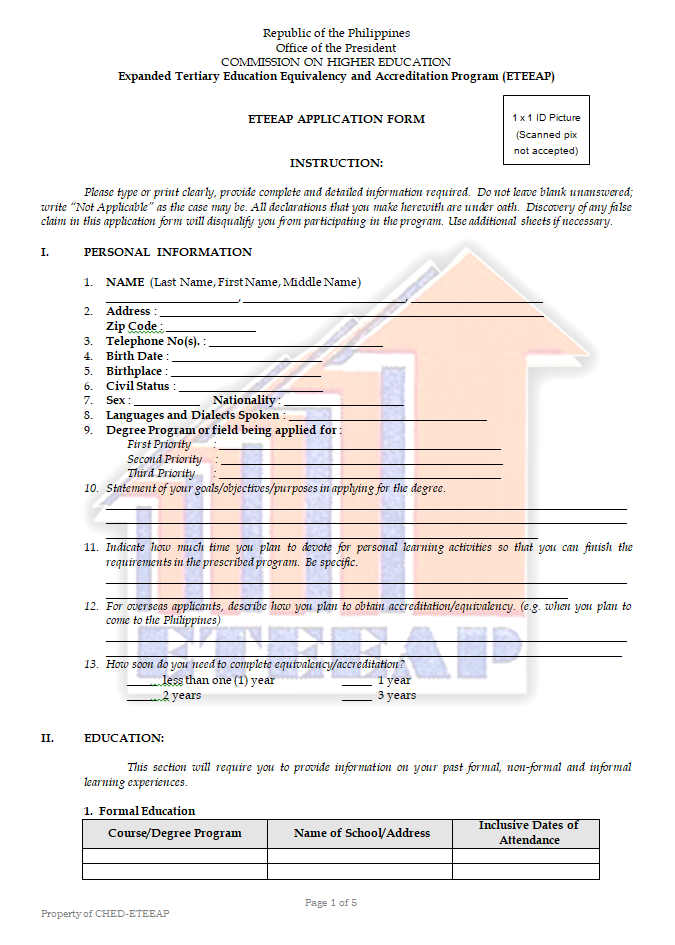
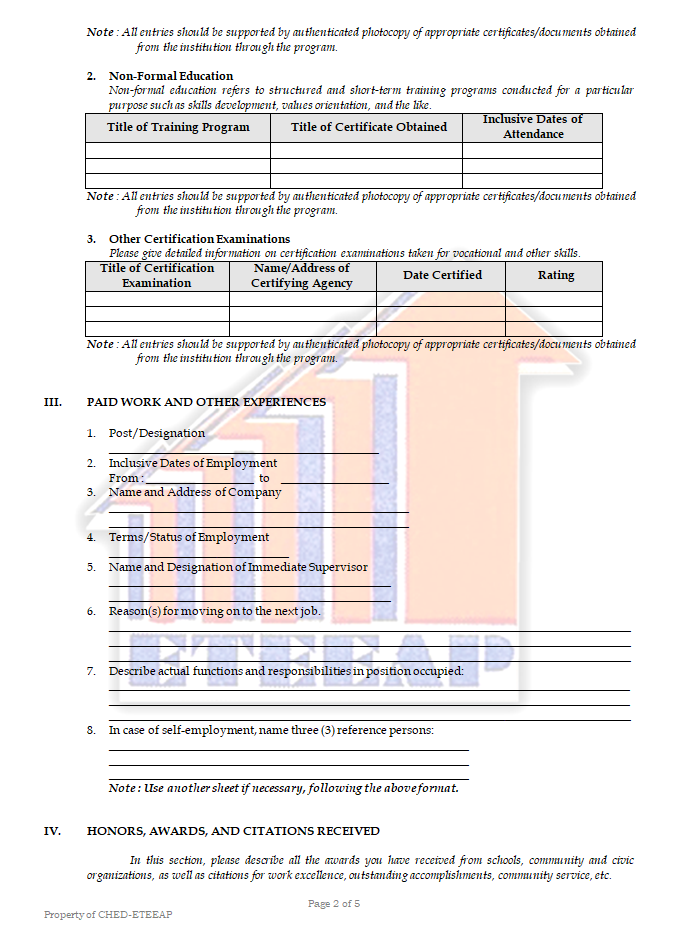
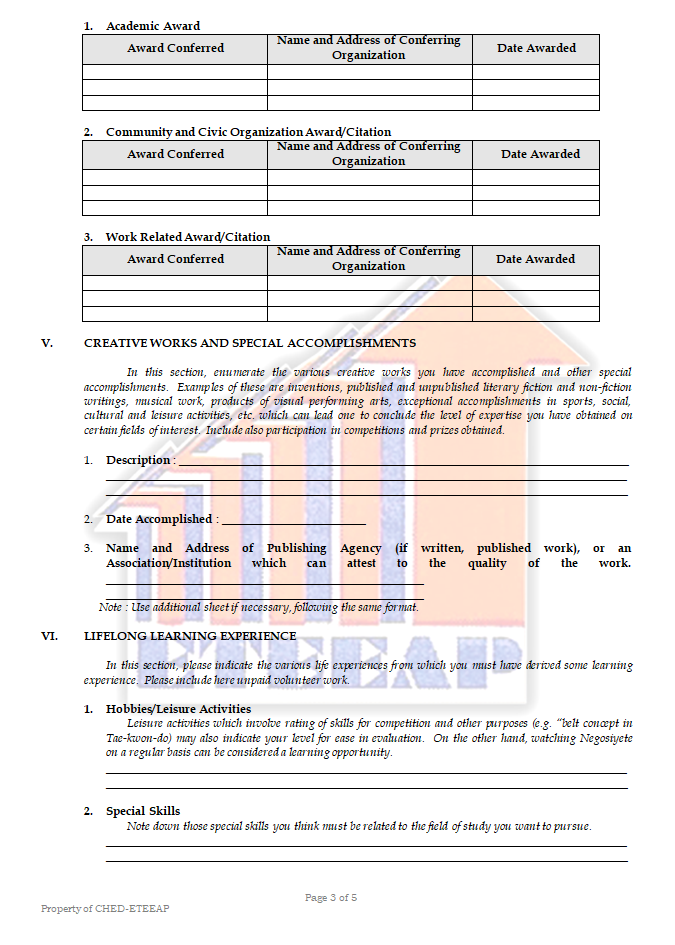
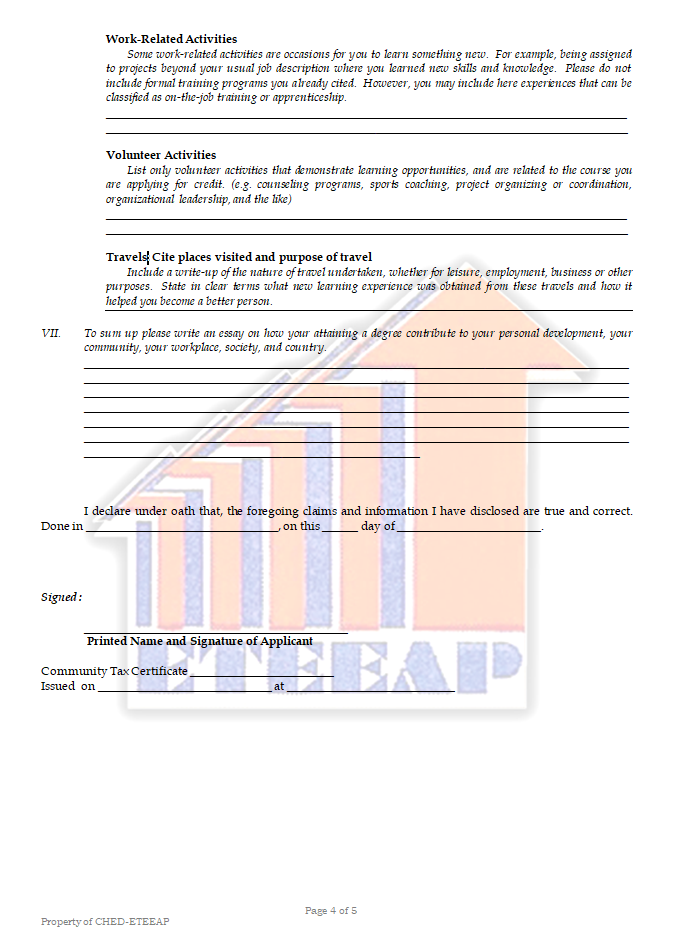
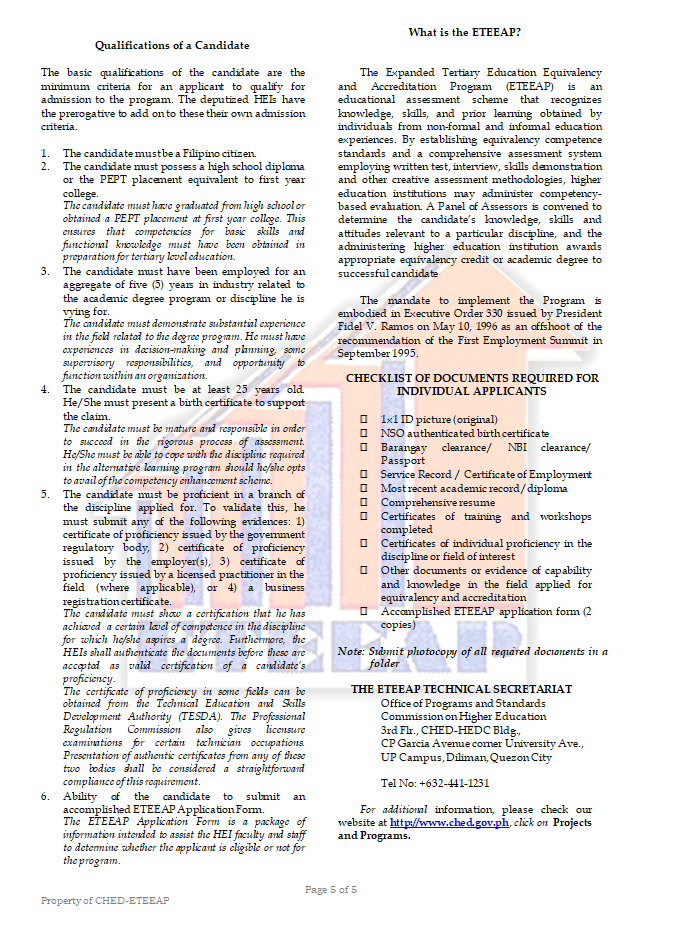
This page contains the application form that need to be completed and submitted to the school where you want to enroll (NOT to CHED). For those who need to prepare other required documents for their ETEEAP application, we have links to the samples at the bottom of the page, below the images. You may visit the pages where these documents were described in details along with their downloadable and editable versions.
As for the application form, the editable version on Microsoft word can be downloaded here, or on the the link located below the image number 5.
Important:Please check your download folder after you click on the download link.
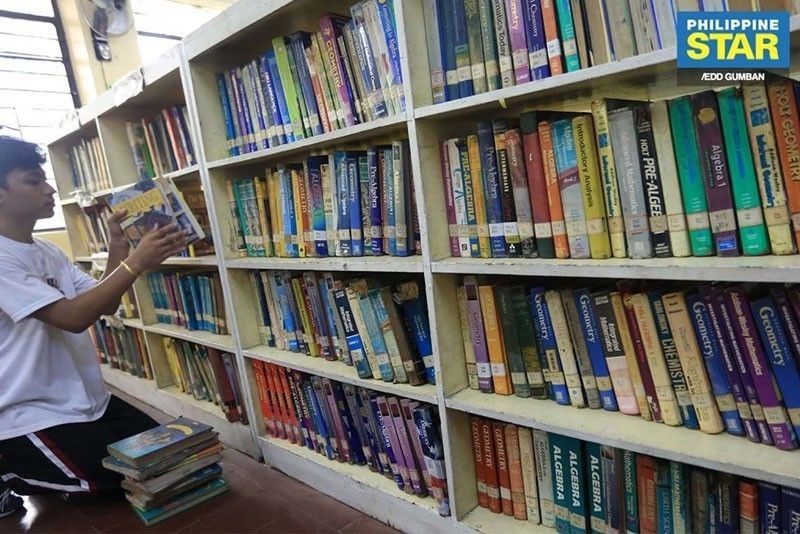
Why are reading skills very important, and what role does it play in our everyday life? How does reading help us understand ETEEAP better and help us get to the right track towards our long-awaited secular degree? An article from the Philippine Star has the following:
“Reading proficiency is essential for a wide variety of human activities – from following instructions in a manual; to finding out the who, what, when, where, and why of an event; to communicating with others for a specific purpose or transaction,” (Italicization is ours)
Here is the whole article taken from the Philippine Star published on December 3, 2019. We can learn a lot about it especially now that distractions abound along with the shortened attention span of not only the younger generation but the older ones as well, and it’s not too late to do something about it. Please read on.
Philippines lowest in reading comprehension among 79 countries
Among 79 participating countries, the Philippines scored the lowest in reading comprehension in the 2018 Programme for International Student Assessment (PISA), according to the results released Dec. 3, 2019..The STAR / Edd Gumban, file
MANILA, Philippines — Among 79 participating countries and economies, the Philippines scored the lowest in reading comprehension in the 2018 Programme for International Student Assessment (PISA), according to the results released Tuesday.
PISA is a worldwide study by the Organisation for Economic Co-operation and Development that examines students’ knowledge in reading, mathematics, and science.
Reading was the main subject assessed among 15-year old students in the 2018 PISA. The Philippines had an average reading score of 340, more than 200 points below China (555) and more than 100 points less than the OECD average (487).
In the Philippines, boys’ and girls’ performances in reading both ranked lowest among PISA-participating countries.
“Reading proficiency is essential for a wide variety of human activities – from following instructions in a manual; to finding out the who, what, when, where, and why of an event; to communicating with others for a specific purpose or transaction,” the summary of the PISA 2018 results reads.
The Philippines also placed the second-lowest in mathematics (353), along with Panama, and science (357). Only the Dominican Republic scored lower in these categories.
China also led the ranking in mathematics and science. The OECD average for mathematics is 489 and the average for science is 483.
“Results from PISA indicate the quality and equity of learning outcomes attained around the world, and allow educators and policymakers to learn from the policies and practices applied in other countries,” a post on the OECD website reads.
According to the PISA 2018 profile of the Philippines, socio-economic status accounts for 18% of the variance in reading performance in the country, compared to the OECD average of 12%.
The country has the largest percentage of low performers in reading among socio-economically disadvantaged students.
The profile noted that average class sizes of 15-year olds in the Philippines are the largest, and the ratio of students to teaching staff in socio-economically disadvantaged schools is the highest.
The Philippines also had the highest percentage of students reporting being bullied at least a few times a month.
For those who need to prepare their documents for their ETEEAP application, we have samples prepared for you. You may visit the pages where these documents were described in details along with the downloadable and editable versions of the documents. Here are a few of them:
For those who need to prepare their recommendation letters and the company does not have a ready template, or has no idea what information to include, we have three samples below. Some or the parts of the documents were hidden to protect the original owners and the companies who provided them.
Sample #1
Sample #2
Sample #3
ETEEAP Application form
If you need an editable version of the ETEEAP application form, you may download it here.
For those who need to prepare their detailed Service Record or Duties, Functions and Responsibilities (DFR) for their ETEEAP application, here is a sample prepared for you. You may download the PDF version of the images, and there is also a MS Word version that can be edited. You can find the download links below the images.
Please help yourself.
Important: The ones in red should be edited according to the information about you. The ones in blue are samples and should be edited with information that match your circumstances and experiences.
You may download the PDF version of the sample DFR here.