This page is a comprehensive guide for beginners who had just recently learned about the ETEEAP. Feel free to explore the different topics about the program below.These will guide you to the right direction.
Ano ang ETEEAP?
Complete information that will help you understand the program. Please click or tap on the link below.
Nandito ang Implementing Rules and Regulations (IRR) ng ETEEAP sa link sa ibaba. Basahin ninyo at intindihin kung paano ini-implement ng mga school ang batas na ito.
After years of providing free assistance and guidance to ETEEAP applicants with this free information website, we are delighted to announce that we are also extending a paid assistance system to those who still need help in their document preparation with a minimal fee.
Why paid Assistance?
Our paid assistance is not a scam.This website has provided all the needed information for anyone who is interested in the program from the requirements, procedures, schools list and other relevant information and needed guidance in joining the program, and it is all for free. You are free to explore this website for all the information you need about the ETEEAP (You can find the links to the free guides at the bottom of this page). The admins also through their Facebook community and pages along with other media platforms are providing free guidance and assistance.
There is also a ‘You do everything yourself‘ or we call ‘The DIY Option‘ But if you still cannot follow and need additional guidance and assistance, or someone who can facilitate your application for enrollment, it is fair then that you should pay for that.
This arrangement was setup as a third-party entity to help or assist interested ETEEAP applicants and enrollees who cannot print their documents, shipping them to the school as well as other on-campus needed transactions and procedures are complicated, expensive and time-demanding processes. It is especially for OFW’s who cannot process their application on campus and communication and coordination with the school is a challenge due to time zone difference and other factors. It also benefits local applicants who have no printing facilities and where shipping documents to the school may take longer, pose the risk of loss along the way as well as other factors. Also in most cases, those who thought they have all the needed requirements still failed to earn the minimum evaluation score, or requirements, to be able to enroll. And this is one reason why we offer our services to minimize the frustration and disappointment of getting into a perceived dead end.
What are included in these services?
This is beneficial for you in the following aspects:
Saves time in producing the right documents.
Protect your original documents from getting lost.
Saves money and time on securing and printing unnecessary documents.
Saves time and money on shipping your documents.
Assurance that all required documents are submitted, and you are given proper advice on what to submit as well as those you still need to submit.
If you cannot personally organize your credentials and deliver them to the school for evaluation, you just send us the electronic copies of your requirement, we will print, organize your portfolio and deliver it to the school for evaluation. Usually when the school receives your portfolio, they contact you directly. But if needed to some schools, we may also continue to coordinate with them in your behalf for the progress of your application.
Once your documents are submitted, we immediately know the program that the school will suggest to align with your credentials.
We also assist you in applying to multiple schools.
Please take note that after your documents were submitted, communication will be between you and the school. We, however, continue to coordinate between you and the school until your enrollment, if needed. Further, we do not assist in producing requirements that you do not have, especially fraudulent documents. The cost of the needed services and complete details are discussed below.
Please noteon Notarization of documents (where the school needs some documents be notarized): Our service fee does not include the notarization fees. You may submit your documents for the purpose of organizing them and for the initial submission to the school (pre-evaluation). If they require notarization of documents, that is the time you can have them notarized, scanned and resend the whole set of electronics copies with the notarized versions.
We assist and facilitate for the following institutions:
DMMMSU, La Union (DMMMSU)
For more information about this university, you may want to visit this link, or this image link if you have not seen their page yet.
We assist for this school as their programs are also aligned with the work of most of those interested ETEEAP aspirants. DMMMSU’s learning modality, which is full modular, is also the most convenient.
If you wish to continue with this school, please continue reading the “Our Assistance Services” section below.
University of the Cordilleras (UC-BCF)
We assist for this school as their programs are the most south-after by, and aligned to, many ETEEAP aspirants. Their learning modality also is the most convenient along with the total cost of completing their degree.
For more information about this university, you may want to visit this link, or this image link if you have not seen their page yet.
You may also visit this link to the sample computation of the total expected cost.
If you wish to continue with this school, please continue reading the “Our Assistance Services” section below.
University of Baguio (UB)
For more information about this university, you may want to visit this link, or this image link if you have not seen their page yet.
We assist for this school as their programs are also aligned with the work of most of those interested ETEEAP aspirants. UB’s learning modality, which is full modular, is also the most convenient.
If you wish to continue with this school, please continue reading the “Our Assistance Services” section below.
Assistance for Other Schools
We also assist for other schools of your choice if you need services or assistance in preparation of your requirements and organizing your portfolio according to the school’s procedures and instructions. But then again, we do not assist in producing requirements that you do not have, especially fraudulent documents.
If you wish to continue availing of our assistance, please scroll down to the section ‘Our Assistance Services‘.
Our Assistance Services
Now let’s go back to the services that we are offering.
Terms, Conditions and Procedure
Accountability release (Disclaimer): We would like to emphasize that this offer is not sanctioned by, nor we are partner with, any ETEEAP school. It is our own third-party services that you may choose as option and we want to clear the school (to which you intend to apply) of any responsibility.
This does not guarantee your automatic enrollment with the school you are intending to send your documents. This is just one process of your application, and the rest of the procedure still depends on you and the school of your choice. Furthermore, the quality of your credentials also has a bearing on the result of the evaluation.
We are not the one creating your documents and we do not produce fake and fraudulent documents. We only assist and guide you on how you prepare your requirements with samples and links to where you may be able to acquire certificates and other supporting documents.
A fee of Php 5,000.00 is required for these services. This is paid upon confirmation that you want to avail of our services. Payment is through G-Cash or bank transfer to one or these banks: BDO-Unibank, or CIMB accounts. The fee covers guidance in preparing your requirements before submission to the school (PrepCon). This however, does not cover the printing of your credentials and organizing your physical portfolio along with the submission to the school. Additional service cost will be Php 3,500.00 for the first school, and Php 2,500.00 for each additional school where you want to apply (We can submit applications to multiple schools, then you choose which you prefer if you get approved by more than one. For example, if you want to apply at one school, the total consultancy service fee is Php 8,500.00. If you want to prepare and submit separate application portfolios for two schools, the fee shall be 11,000.00, and so forth. Other added cost depends on the school and the required fees upon submission. For example, one school requires 2,200.00 application fee upon submission of a student’s portfolio. Then you need to add this to the total amount you will pay when you avail of our services.
Other fees may be added if the school requires more than 1 set of portfolio. In such case, additional portfolio will be Php 1,500.00 each.
Please be aware again that the above-mentioned fees do not cover any required notarization of your documents. You need to enquire at the school as to what type of notarization is needed, which we will facilitate between you and the school. As for transmission or shipping, it includes 1 set of printed portfolio. But if another set needs to be printed and prepared, please see number 9 below for the details.
Important: You need to fill out the Applicant Declaration and Agreement Form in the link you can find below to signify your acceptance and agreement with the terms and conditions of these services. You also need to pay the service fee, and the payment procedure is also in the form. But before you do that, please read the rest of the conditions.
After payment, we will start the process of assisting you in your documents preparation. We will guide you through the WhatsApp chat below, email thread or/and forms you will be filling out. We will not answer any questions and clarifications you will send through email and WhatsApp unless you already paid the service fee.
When the electronic version of portfolio has been completed, we will print all your your documents, bind them into a portfolio according to the school’s procedure and deliver it to the school for evaluation. Again, please be aware that this agreement (including the above-mentioned fees, depending on your choice and option) only covers printing and preparation of your portfolio/s and for submission to the school/s either by shipping or direct walk-in delivery. Follow up for the result of your evaluation will be your responsibility and communication will be between you and the school once they receive and accepted the application. When needed and in a limited basis, we also may represent you for your transactions at the school on some pre-enrollment procedures.
Either you pass or fail the pre-evaluation, the school will inform you. As for UC-BCF and UB, we are immediately informed whether you qualify, or still need to submit additional credentials, at the time we submit your portfolio. For other schools, you will do the follow up with them directly.
You need to create an email account with GMAIL (if you don’t have one yet) as this is needed in the whole process of your document preparation. You will also need this email account when sharing documents on Google Drive with us and with the school you will be enrolling at.
If extra sets of portfolios are needed, there is an additional fee of PHP1,500.00 for each additional set. This fee can be paid as needed.
For some schools like UC Baguio, after you paid the required service fee and upon our submission of your portfolio, the school will arrange a video conference orientation for you with the head of their ETEEAP department/Dean of teacher education.
Note on refund:
– The following is the only reason we can partially refund your payment: If you realized that your work experience was not aligned with DMMMSU’s programs and yet you paid for the services, you only have 48 hours from the actual time you paid to request for a refund. 50% of the total mount you paid will be refunded to you. The reason:You need to be serious and fully understand what ETEEAP is, and that you have fully decided, and are determined, in joining this program, not just school-shopping.We are serious in assisting applicants and we mean business, and you should also be. – If your work experiences are aligned with your chosen school’s programs and you want to request for a refund on any reason, we won’t refund but instead move your application into the dormant applicants. The same as when we started with the process and you decided not to continue. You have one year from the date of your payment to resume your application. If you have no action within one year after the actual payment, your fee will be forfeited. However, this forfeiture can still be negotiated depending on the circumstances and the reason why you did not continue at the start. The reason:You need to be serious and fully understand what ETEEAP is, and that you have fully decided, and are determined, in joining this program, not just school-shopping.We are serious in assisting applicants and we mean business, and you should also be.
Legal Binding(Important Legal Notice)
If you do not agree with the above terms and conditions after reading this page and the agreement form, please do not continue. Moving forward to signing and submitting the Applicant Registration and Agreement Form in the link below, along with paying the service fee, is an indication that you have read and understood, and agree with, all the provisions stated on this page and in the form.
Procedure
If you agree with the above, you can start filling out the Applicant Registration/Agreement Form below.
Pay the corresponding service fee and follow the guidance of the form. All instructions and payment details are in the form as you answer each question.
Then contact us through the email in the form to start the process.
If you agree with the above terms and conditions, please open and carefully follow the instructions in the form in the link below. After completion and submission of the form and then notifying us, you will be directed to another instruction that will guide you through the whole process of preparing your requirements.
Thank you for trusting us. Please be assured that we will provide you the best services you deserve. We also assure you that these services are legitimate.
If you wish to explore
Free Guides on this Website
You may still want to review some important information about the program on the pages in the link below. Please help yourself while you are deciding, or waiting for our response to your application if you already submitted it.
Thank you for visiting our site and we hope the information you found are useful to you. If you have other questions on topics that were not covered by our articles, you may send them through the form or comment section below and we will address them.
We also answer questions of our Facebook Group members here. You can send your questions in the form and comments section below.
Q: Ano ang ibig sabihin ng ‘Minimum Residency’ na kinakailangan ng isang estudyante sa school na eenrollan niya? A: Tumutukoy yan mula sa official enrollment ng isang estudyante sa school. Kapag sinabing 6 months minimum residency, hindi siya pwedeng mag-apply for graduation (o mag-enroll sa susunod na semester kung may isa pang semester na tatapusin) kung hindi pa natatapos yung residency period na 6 months. Ito ay kahit natapos na ang lahat ng klase at module ng estudyante. At 6 months ang pinaka-minimum na residency na required sa mga school na implementor ng ETEEAP. May iba pa na one year (12 months) ang minimum residency, lalo na sa mga technical program tulad ng engineering. Kaya kapag may nagsabing ga-graduate ang estudyante in 6 months ay hindi yun totoo dahil kapag nag-apply for graduation ay aabutin pa ng 3 months (minsan ay mas matagal pa) na ma-process ang mga document kasama ng coordination at submission sa CHED bago ang graduation.
Nakakatawang unawa na hindi ito ang kahulugan: Kailangan mong tumira sa lugar kung nasaan ang school sa loob ng 6 months bago ka makapasok at maka-graduate.
Q: Dati kung work ay Operations Manager ng Restaurant for 11 years, at sa ngayon nasa hotel as a Hotel Manager. May 2 years course akong natapos sa HRM, at 6 months Caregiver. 48 years old ako ngayon. May age limit ba? A: Kahit hanggang 100 years old ay pwede basta not younger than 23 years old. Pwede sa BSBA Operations Management para kahit hindi hotel ay pwede kang makapasok. Pero kung gusto mong ituloy yung HRM mo ay pwede pa rin at aligned din naman sa trabaho mo.
Pwede din na ma-align yan sa Bachelor of Industrial Technology, majoring in Food Service Management yung 11 years mong managerial experience sa restaurant, at baka mas malamang na ma-approve yan. Tingnan mo ang link na ito para sa detalye. https://eteeap.org/fsm
Is it possible na mag-submit ng docs for assessment to different schools para may back up? – The answer is yes. Additional advise is to compile all your documents in the proper order as described on this link. An then save them into a properly labeled folder and zip the folder before sending to the schools.
If magsusubmit ba ko ng requirements, need ba physical na pupunta sa school or can I send it via email/online? – Depende yan sa school. Karamihang schools ay ipapadala sa email ang mga document. (Additional advise is to compile all your documents in the proper order as described on this link. An then save them into a properly labeled folder and zip the folder before sending to the schools.)
If physical kong isusubmit requirements, kelangan ba original lahat? Kasi if yes, di na ko makakapagtry sa ibang school. Okay sana kung pwede photocopies lang. – Hindi dapat hingin ng mga school ang mga original document. Ipapakita lang yan kapag face-to-face (o sa virual) na interview na. Hindi sasagutin ng school ang document ninyong nawala sa poder nila. At kahit pananagutan pa nila yan, napakahirap kumuha uli ng kapalit.
Update: May ibang school na kinukuha ang mga original kapag enrolled na ang estudyante nila. Ibabalik nila yan kasabay ng diploma at OTR ng applicant kapag gagraduate na.
I have one COE lang which is from my current employer and I’ve been with them for 6 years. Is that okay po? – Yes. As long 5 years or more work experience, it is enough. Mas may advantage kung may iba pa dahil may additional points every additional year ng work experiences. Ang mga training, seminar at iba pang learning certificates ay nabibigyan din ng points sa evaluation para makompleto yung 50 or 60 points requirement na matangap sa ETEEAP.
Yung mga nag-ooffer po ng assistance for enrollment and nanghihingi ng payment agad, legit po ba sila? – Walang initial payment na hinihingi ang mga school kapag nag-submit ng application for evaluation. Kapag approved na ay saka sila magpapadala ng evaluation form at nandoon na rin ang mga babayaran ng aplikante.
Face to face o inperson (F2F or IP) learning – Pupunta ang estudyante sa school at doon mismo mag-aral kasabay ng iba pang mga estudyante. Ito ay tinatawag na SYNCHRONOUS LEARNING.
Online Learning – Hindi pupunta sa school ang estudyante ngunit mag-aaral din ito kasabay ng iba sa pamamagitan ng mga online learning tools tulad ng Zoom, Google Meet at Clasroom, Messenger at iba pang virtual conference tools. Synchronous learning din ito.
Modular Learning – Hindi pupunta sa school o sa online ang estudyante kundi matatanggap niya ang mga lesson niya sa door to door delivery, email o sa school portal at gagawin niya sa sariling schedule ang pag-aaral saka niya i-submit ang mga assignment niya sa pareho ding paraan ng pag-deliver sa kanya. Ito ay tinatawag na ASYNCHRONOUS LEARNING.
Hybrid Learning – Ito ay anumang combination ng number F2F learning, online learning, at modular learning. Mayroong hybrid online-modular (HOM) at hybrid inperson-modular (HIM) o hybrid face-to-face and modular.
SYNCHRONOUS LEARNING – Sabay-sabay na mag-aral ang mga estudyante sa loob ng classroom o iba pang bahagi ng school campus, o sa pamamagitan ng mga virtual conference tools tulad ng Zoom, Google Meet, at Messenger.
ASYNCHRONOUS LEARNING – Hindi sabay-sabay ang pag-aaral at tatapusin ng estudyante ang mga assignment niya sa module na ipapadala sa kanya, sa pag log-in sa school portal o LMS, o sa Google Classroom ng school.
Your may send your questions in the form below. Our answers could be from the information coming from the other parts or sections of this site, or we can inquire from reliable sources for accurate answers, of which you may need to wait.
We will protect your identity and assure you that you won’t get scammed when enquiring from us. So we encourage you to trust us.
There were also questions that were answered in the comment section below.
We also welcome comments and suggestions on how we can improve our services.
This page covers extensive discussion on how state universities and colleges (SUC) as well as private schools and universities evaluate ETEEAP applicants’ credentials. This will help aspiring candidates understand the procedure and prepare their portfolio properly to be able to pass the evaluation and assessments at the first attempt if possible. It is also helpful for those who failed the initial evaluation as to what else they need to prepare and submit to the DHEI to be able to pass the re-evaluation.
Although each ETEEAP DHEI was given autonomy on how to set-up their own system, they still have to closely follow the guidelines provided by the Commission on Higher Education (CHED) in implementing ETEEAP. Accept or admit it or not, there has to be one similar to a point system that should be guiding institutions in evaluating their applicants.
ETEEAP students should be well-rounded in the field where they have experience to be able to qualify into the program. All schools follow the same principle of setting up equivalent score for each evidence presented by the applicants. Although some schools/universities do not mention this openly (or not specifically state that they use the point system), some schools, particularly state universities, do. In the first place there should be a way to determine the equivalent of a credential submitted by the applicant and that is through a standardized scoring system which each school should setup based on CHED’s guidelines. State universities strictly follow this formula and we will use one or two examples of how SUC’s implement this. This will also clear up doubts on the integrity of the evaluation systems used by DHEI’s as some applicants have expressed.
Let’s take a look at one state university’s requirement and compare it with another state university’s evaluation criteria.
The example below was extracted from PUP’s ETEEAP website which contains the requirements an applicant should submit. This is one of the state universities that most members of the ETEEAP community know very well and their website is abundant in needed information about the program. You can find the complete information on their website in this link.
Requirements for Admission
Letter of intent to avail of the program addressed to the University President through the Executive Vice President and Office Director
Accomplished ETEEAP application form
Comprehensive curriculum vitae
Most recent academic record (Form 137 or original transcript of records)
Honorable dismissal and subject descriptions from the institution where applicant was last enrolled
Service record or certificate of employment
Appointment and duties, functions, and responsibilities (DFR) of each position held
Latest 2×2 picture (2 pcs) white background
Original birth certificate (NSO authenticated)
Original marriage certificate for female applicant (NSO authenticated)
Other documents, such as but not limited to:
certificate of participation and/or attendance to seminars/trainings/conference/colloquium or forum attended;
recognition or award/s received;
relevant licensure and other professional exams passed;
copy of research and/or articles published;
certificate of membership;
and the like.
In the above example under the ‘Other documents, such as but not limited to:’, there are five categories of documents (in red). These are the ones that needed thorough evaluation and each of these categories have corresponding equivalent (score or points) to enable the applicant gain the minimum requirement for enrollment in the program. Let us now compare this with another state university’s evaluation instrument or credential score guide, Pangasinan State University (PSU), which was proven effective in implementing the ETEEAP because of the high licensure scores of their alumni.
We won’t present the actual or exact evaluation document/instrument they are using, but the criteria or areas in which they evaluate an applicant’s credentials and the maximum score each can earn. In this way, aspiring candidates have idea as to why they failed the evaluation despite submitting more than a hundred pages of credentials, while others who submitted less than fifty pages passed and were able to enroll.
This is a sample evaluation scoring guide to determine ETEEAP applicants’ competencies and qualification. This however does not reflect or contain the exact value the schools are using. The numbers are only used for illustration purposes. While schools use the same principle in evaluating an applicant’s competency, there is a discretionary variation of 5%-10% difference between institutions and evaluators.
SUCs strictly follow the guidance of this instrument while some private institutions are more lenient in some areas but they require the students to enroll more subjects along with added tasks and projects to compensate for the lacking credentials. This explains why some applicants who failed their SUC evaluation passed in some private institutions. The trade off is longer stay with the school and more expense.
As for SUCs, applicants who earn the minimum evaluation score will be required to enroll the maximum number of units. As the score increases beyond the minimum, the required units is lessened. Most of the remaining units the applicants are required to enroll cover the major courses or subjects. If applicants fail to meet the minimum score, it’s either they are not accepted, or required to submit additional requirements.
Page 1
Page 2
Now let’s create different scenarios out of the evaluation instrument above. Although the examples below do not reflect exactly how schools evaluate their applicants, these give us the idea on where the evaluation scores are coming from. These help applicants how they should prepare their credentials and which areas they need to focus on.
Let us compare the different examples, and as you look at each of the scenarios, take note of differences on the scores given to the submitted credentials. One more area to focus on is the score given to the relevant training certificates.
Scenario 1 (Applicant 1)
Documents submitted
Score Earned
College credentials (undergraduate)
18
Five years relevant work experience with complete COE/DFR
15
100 relevant training certificates
5
Drivers license
3
Birth certificate, passport, application form, intent letter
0
Total score earned (Failed)
41
Scenario 2 (Applicant 2)
Documents Submitted
Score Earned
High school credential
10
10 years relevant work experience with complete COE/DFR
20
10 relevant training certificates
5
Drivers license
3
Community services (relief operations and tree planting)
4
Awards and recognitions at work
6
Birth certificate, passport, application form, intent letter
0
Total score earned (Failed)
48
Scenario 3 (Applicant 3)
Documents Submitted
Score Earned
High school credential
10
Relevant TESDA certificates (Considered as vocational)
4
10 years relevant work experience with complete COE/DFR
20
100 relevant training certificates
5
Community services (relief operations and tree planting)
4
Awards and recognitions at work
6
Rotary club membership
5
Drivers license
3
Birth certificate, passport, application form, intent letter
0
Total score earned (Failed)
57
Scenario 4 (Applicant 4)
Documents Submitted
Score Earned
High school credential
10
Relevant TESDA certificates (Considered as vocational)
4
15 years relevant work experience with complete COE/DFR
25
15 relevant training certificates
5
Community services (relief operations and tree planting)
4
Awards and recognitions at work
6
Rotary club membership
5
Drivers license
3
Birth certificate, passport, application form, intent letter
0
Total score earned (Passed)
62
Scenario 5 (Applicant 5)
Documents Submitted
Score Earned
College graduate credential
20
10 years relevant work experience with complete COE/DFR
20
50 relevant training certificates
5
Community services (relief operations organizer)
5
Awards and recognitions at work (International)
10
Trainor
2
CS Sub-professional
3
Drivers license
2
Birth certificate, passport, application form, intent letter
0
Total score earned (Passed)
67
Scenario 6 (Applicant 6)
Documents Submitted
Score Earned
High school graduate
10
15 years relevant work experience with complete COE/DFR
25
30 relevant training certificates
5
Community services (relief operations organizer)
5
Awards and recognitions at work (National level)
8
Trainor
2
CS Sub-professional
3
Drivers license
2
Birth certificate, passport, application form, intent letter
0
Total score earned (Passed)
60
Scenario 7 (Applicant 7)
Documents Submitted
Score Earned
High school credential + Vocational
14
20 years relevant work experience with complete COE/DFR
30
10 relevant training certificates
5
Drivers license
3
Community services (relief operations and tree planting)
4
Awards and recognitions at work
6
Birth certificate, passport, application form, intent letter
0
Total score earned (Passed)
62
We hope the above information is helpful in your ETEEAP journey.
For a more personalized paid guidance, and if you need a legitimate third party to facilitate your application we provide that. Please visit the pages in the links below.
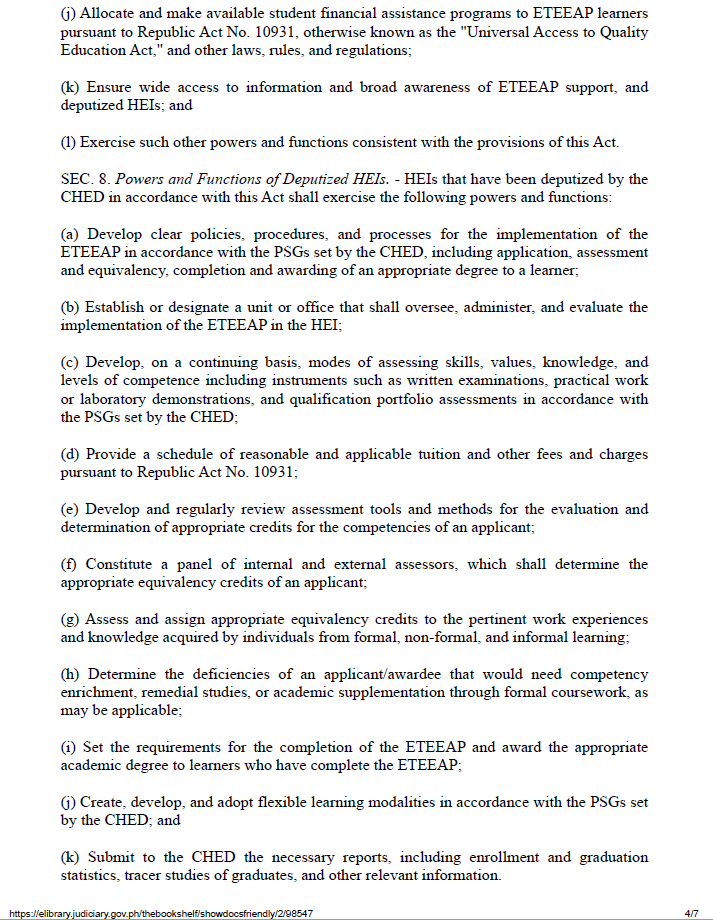
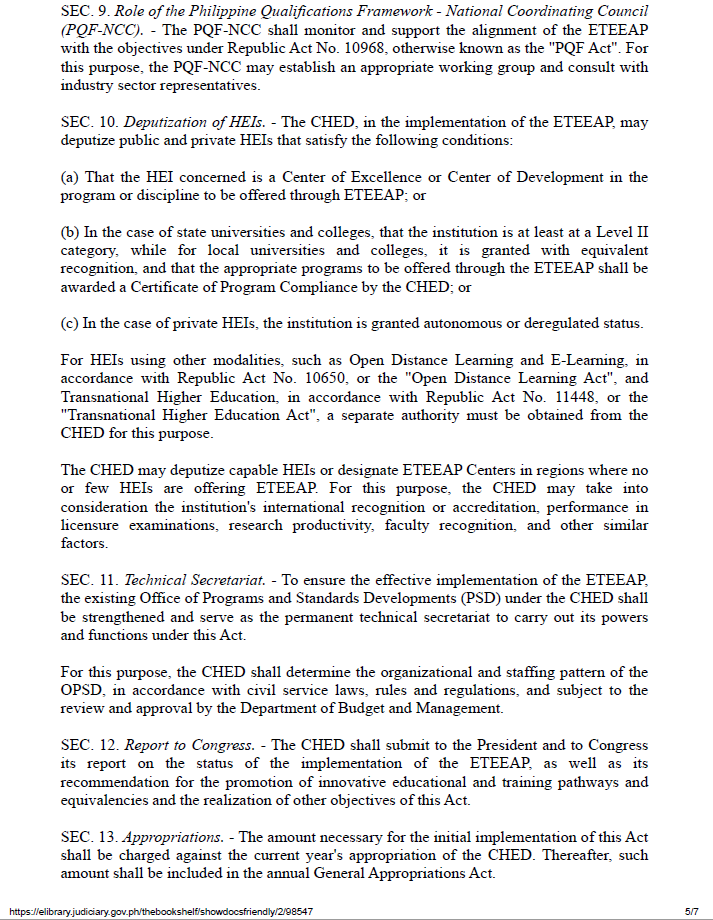
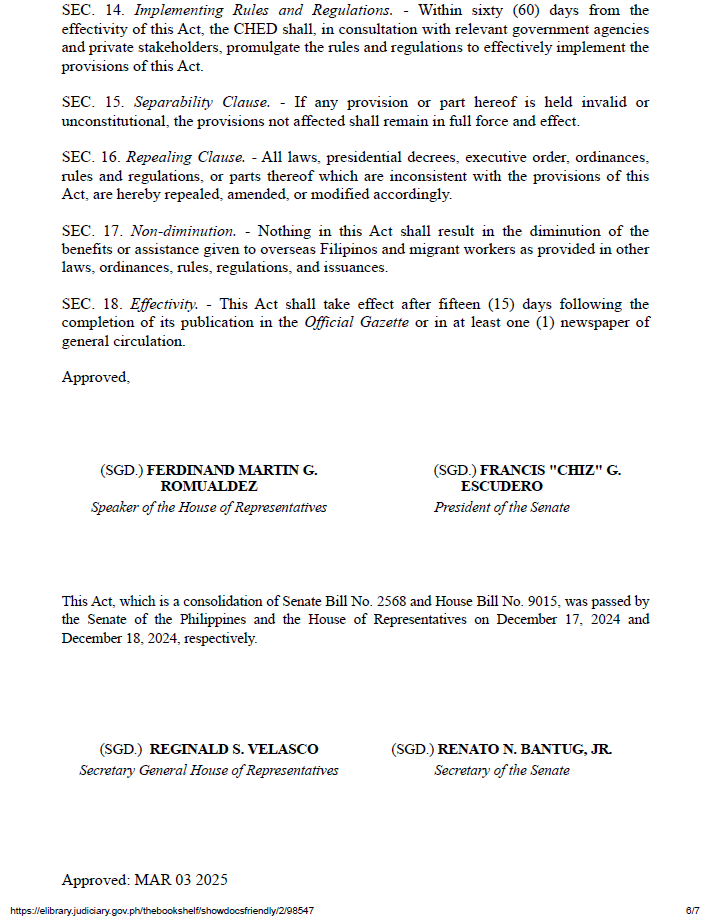
RA-12124 Implementing Rules and Regulations (ETEEAP-IRR) CHED Memorandum Order 11, Series of 2025 (cmo11s2025)
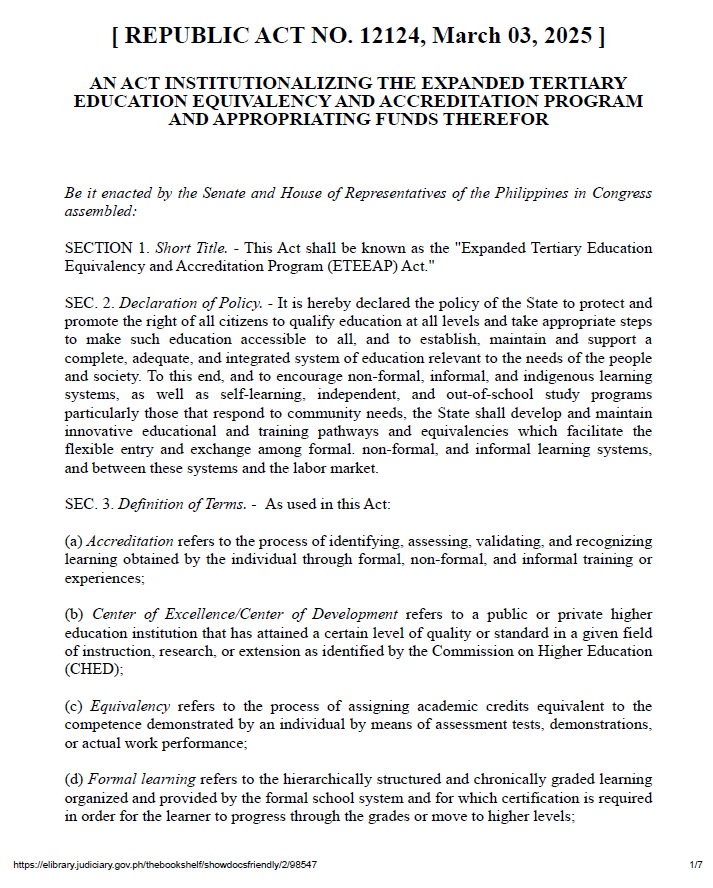
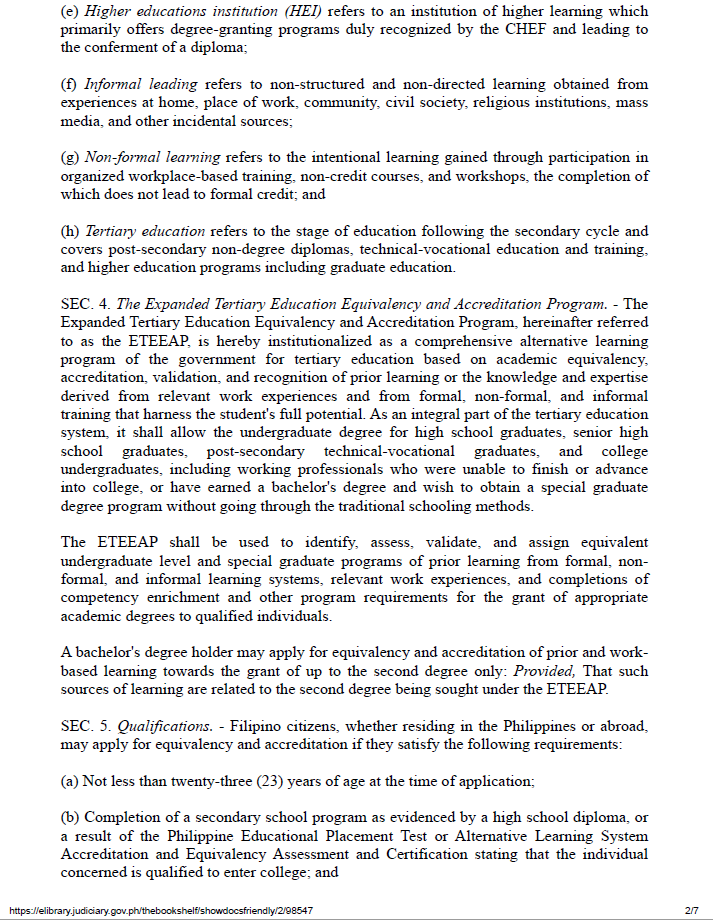
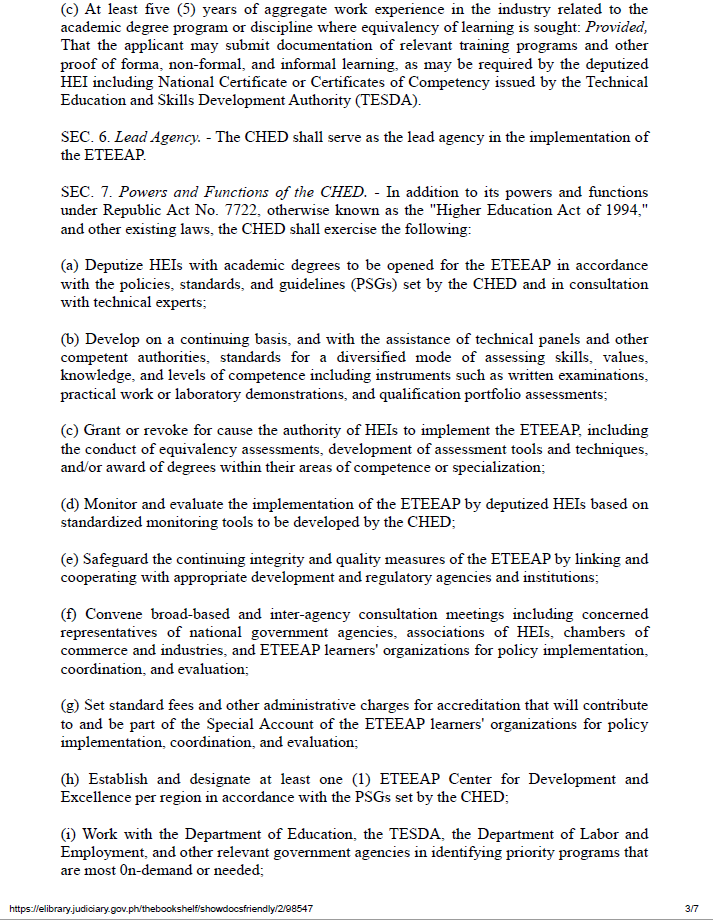
On March 3, 2025, President Ferdinand Marcos, Jr. signed the RA-12124 known as the ETEEAP Bill. This is to establish the May 10, 1996 Executive Order 330 (EO330) of former President Fidel V. Ramos into a law or Republic Act. On June 16, 2025, the Implementing Rules and Regulations (IRR) also known as CHED Memorandum Order Number 11, Series of 2025 (CMO11S2025) was signed and approved.
Below are the images of the 13 page RA-12124 Implementing Rules and Regulations (IRR) or CHED Memorandum Order Number 11, Series of 2025 (CMO11S2025). As stated in Sections 8 and 9 of this CMO, all previous CMO’s and other guidelines in implementing the ETEEAP are superseded, amended, modified and repealed upon the effectivity of this IRR or CMO. The said CMO was approved on June 16, 2025 and took effect on July 1, 2025.
After (or below) the images, you will also find some useful information and background of the ETEEAP and the difference between the EO330 of 1996 and the RA-12124 of 2025.
Difference Between the EO330 of 1996 and the RA-12124 of 2025
On March 3, 2025, President Ferdinand Marcos, Jr. signed the RA-12124 known as the ETEEAP Bill. This is to establish the May 10, 1996 Executive Order 330 (EO330) of former President Fidel V. Ramos into a law or Republic Act.
But why the RA-12124 when we already have the EO330 of 1996? Did we just create a redundancy and the present Marcos leadership wasting their time creating a bill on something that was already in place? Are they not just stealing someone’s legacy and program?
Here is the answer.
Be aware, and many Filipinos are aware, that the Philippine government structure has three main branches which most, if not all, of those who have gone to school have already learned about. These are the following:
The Executive Branch – This is being lead and supervised by the president of the Philippines. Under this branch are the military (AFP), police (PNP), defense (DND), justice department (DOJ), education department (DEPEd), commission on higher education (CHED), department of energy (DOE), department of agriculture (DA) and other departments as part of the cabinet of this branch.
The Legislative Branch – As of the year 2025, this is mainly composed of the Congress and the Senate, which in the Philippines is bicameral (Meaning two chambers, or houses, of legislators). They are responsible for creating laws (bills) that should be implemented by the executive branch and upheld by the judiciary. Although this branch is the one responsible of legislating laws, it is the president who finally signs them and seal them to be called a republic act (RA). That means, the executive branch approves and ratifies the bill, and agrees its full implementation through the responsible cabinet or department under its supervision and jurisdiction.
Judiciary Branch – This branch is responsible for settling disputes related to the implementation and adherence to the laws created by the legislative branch and implemented by the executive branch. It also oversees adherence of the two other branches to the constitution as they carry out their specific mandates. The judiciary makes sure that creation of any law by the legislative branch, and the enforcement of such by the executive branch are within the bounds of the constitution. Violations, disagreements and disputes on any of the laws will be handled by this branch, and any decision it hands down will be implemented by the executive branch through its department of justice, the police and/or the responsible branch of the military.
With the above background, we can see that the EO330 of 1996 (called the ETEEAP) was not a law but was just an operating procedure instituted by the president and directed to a specific department, which was the Commission on Higher Education (CHED) to implement a new project that will benefit out-of-school youths along with those who had to prioritize working at a young age over completing a college degree at that time. And it really benefited a lot of Filipinos. Since such EO did not violate any provisions in the Philippine Constitution, the other two branches never stepped in to stop it.
Five more presidents (Estrada, Arroyo, Arroyo, Aquino and Duterte) came after Ramos but none of them discontinued that operational procedure ordered by their predecessor. However, it was never ratified as a bill or law during their incumbencies. But thanks to them for their continued support for, or for not discontinuing, what former President Ramos had started.
It was only during the presidency of Ferdinand Marcos, Jr. that congress worked on ratifying the ETEEAP bill which was read by the Philippine 19th Congress as House Bill No. 5728 on November 8, 2022, and approved by the senate as the Senate Bill No. 2568 of September 16, 2024 and eventually signed as republic act on March 3, 2025 by the president.
So what is the difference between the EO-330 of 1996 and the RA-12124 of 2025?
The EO-330 of May 10, 1996 was not a law, but was just an operating procedure established by the president and directed to the Commission on Higher Education to implement.
The RA-12124 of March 3, 2025 was read by the Philippine 19th Congress as House Bill No. 5728 on November 8, 2022, and approved by the senate as the Senate Bill No. 2568 of September 16, 2024. Then on March 3, 2025 was signed by President Ferdinand Marcos, Jr.
If you want to know the details of the RA-12124, please visit the links below where you can find images of the downloadable copy in the Supreme Court E-Library link.
On March 3, 2025, President Ferdinand Marcos, Jr. signed the RA-12124 known as the ETEEAP Bill. This is to establish the May 10, 1996 Executive Order 330 (EO330) of former President Fidel V. Ramos into a law or Republic Act.
This is the answer to those who had been questioning the legality of ETEEAP as it was only an Executive Order (EO) and no other laws supported it. It will also strengthen the foothold of the program and further re-enforce the legitimacy of the degrees that were earned by the alumni and alumnae under this program. We hope that the issues brought about by some individuals who refuse to recognize the legitimacy of this program will be silenced once and for all by this RA.
Below are images of the downloadable copy in the Supreme Court E-Library link.
The evaluation is the very first part of the assessment process that ETEEAP DHEIs implement to determine if the applicants are eligible to enroll in their program.
The schools usually require the applicants to submit between 1 and 3 sets of their portfolio (credentials), one consisting of all the original documents, and the other two are photocopies. Other schools require only 1 set of photocopies. One of these (if more than one) will be kept in the permanent student record of the school for future reference, just like they do on regular program students.
Along with the submitted documents is the corresponding evaluation fee that ranges between PHP5,000.00 and PHP25,000.00. Some private schools require this fee upfront as soon as the applicants submit their letter of intent along with their application form and other credentials. For others, this is paid if the student passed the pre-evaluation and already qualified for the next step of the student’s application which is usually the interview with the panel of experts. For the latter, the student already qualified and the evaluation panel interview is only to determine the level of expertise of the applicant which is needed by the school to appropriate the equivalent courses (subjects and units) that will be covered by his/her work experiences and informal trainings. Then the school will determine the courses the student needs to enroll to complete all the requirements to be awarded a bachelor’s degree.
Does paying the evaluation fee ensure that applicants will be accepted? Yes and No and that depends on the school. In the previous paragraph, there are two ways schools collect the evaluation/assessment fee. With the former, it is still uncertain, but with the latter as explained the student already passed the pre-evaluation and the fee is only for the final determination of how many subjects the student still needs to enroll. Is there still a possibility that the applicant will fail in this stage? Yes if the panel notices inconsistencies in the applicant’s statements and answers to their queries, if they find out the applicant is lying, and/or if they find out that the applicant submitted fraudulent documents.
The evaluation process is when and where the applicants’ credentials are examined and scrutinized by the industry experts in the field the applicants are requesting to enroll in. These experts could be the professors of the specified field, or external. The evaluation is not part of their paid job description, and therefore should be paid. Thus the evaluation fee, and therefore is not refundable in most cases, whether the applicants passed or failed the evaluation because the services (which is evaluating the applicant) has been delivered. If the applicants fail, most, if not all, do not refund.
If the applicants passed the evaluation and are accepted, the fee is normally deductible to the whole package fee of the program.
Some schools, especially state universities, do not require evaluation fees upfront. These will only be paid if the applicants passed the evaluation. These are referred to as ‘Evaluation Fee’ or ‘ETEEAP Accreditation Fee’ (either or both appear separately) in the assessment form the students will receive to continue with their enrollment process.
To avoid getting scammed, the applicants are advised to pay these fees directly at the school cashier, or any designated payment system the school has instructed them.
Para saan ang Evaluation, o Assessment at ETEEAP fee?
Ang EVALUATION ay ang pinakaunang prossesso ng assessment na ginagawa ng school para tingnan at busisiin ang mga credential ng mga aplikante kung eligible silang mag-enroll sa ETEEAP (Yan yung ibig sabihin ng Equivalency and Accreditation sa acronym na ETEEAP). Ibig sabihin, pwedeng pumasa o bumagsak ang aplikante sa prossesso na ito.
Kapag ang school ay nag-require ng evaluation/assessment fee bago nila umpisahan ang prossesso, yan ay non-refundable sa karamihang school (baka sa lahat pa nga ng school, at karamihan ay private colleges at universities), pumasa ka man o hindi. May ibang school na saka na lang magbayad ng evaluation fee kung tapos na at pumasa sa pre-evaluation (Karamihan ay state universities, pero may mga private institutions naman na mas considerate at ‘pay only if you passed the evaluation’). Ang tawag sa babayaran na ito sa assessment form ay ‘Evaluation Fee’ o kaya ay ‘ETEEAP Accreditation Fee’. Sa ibang kaso ay magkahiwalay na makikita itong dalawang impormasyon.
Kapag pumasa sa evaluation ay deductible ang evaluation fee na babayaran sa total amount ng buong program (kung upfront o binayaran bago mag-umpisa ang evaluation).
Bakit may ganitong fee?
Dahil ang mga mag-eevaluate at mga expert sa field ay hindi kasama sa kanilang suweldo ang trabaho na ito kaya kailangan silang bayaran regardless kung pumasa o hindi ang applicant (Hindi laging employed sa school ang mga evaluator. Minsan ay external ang mga ito na pupunta lang sa school para mag-evaluate ng mga credential ng mga applicant sa ETEEAP. )
Ang range ng evaluation fee ay 5k hanggang 25k depende sa school.
Para hindi ma-scam ay doon sa school mismo magbayad, hindi sa agent. O mag-verify muna sa school kung pwedeng sa agent ibigay ang bayad.
We are delighted to announce that we are extending assistance to ETEEAP applicants who need help in their document preparation for the ETEEAP schools of their choice with a minimal fee.
This website, along with its social media platforms and other collaborating sites, have provided all the needed information for anyone who is interested in the program from the requirements, procedures, schools list and other relevant information and needed guidance in joining the program, and it is all for free. You are free to explore this website for all the information you need about the ETEEAP. But if you still cannot follow and need additional guidance and assistance, it is fair then that you should pay for that. It is not the submission of your requirements to the school that you are paying for because that is free, but rather the services that you needed to assist you in your preparation since you cannot follow the comprehensive free information and self-explanatory guidance. (Ang website na ito, kasama ng associate na mga social media platform at iba pang mga supporting site, ay nagbigay na sapat na libreng imposmasyon at gabay para sa mga intresadong mag-apply sa ETEEAP. Ngunit kung hindi pa ninyo masundan ang mga ito at kakailanganin pa ninyo ang karagdagang gabay at assistance ay nararapat lamang na bayaran ninyo ang extra services na ito. Hindi ang pag-submit ng mga requirement ninyo sa school ang babayaran ninyo sapagkat ito ay libre. Ang babayaran ninyo ay ang extra services ng paghahanda ng inyong mga requirement dahil hindi ninyo masundan ang mga libreng information at procedure na madali din namang maintindihan.)
This is beneficial for you in the following aspects:
Saves time in producing the right documents.
Protect your original documents from getting lost.
Saves money and time on securing and printing unnecessary documents.
Saves time and money on shipping your documents.
Assurance that all required documents are submitted, and you are given proper advice on what to submit as well as those you still need to submit.
For some schools, this eliminates submission of hard copies of your documents on the initial stage of your application. As for schools that require printed copies at the initial stage of application for evaluation, it will also be helpful.
Please noteon Notarization of documents (where the school needs some documents be notarized): This is not part of these services. You may submit your documents for the purpose of organizing them and for the initial submission to the school (pre-evaluation). If they require notarized documents, that’s the time you can have them notarized and resend the whole set with the notarized versions.
Now let’s go back to the services that we are offering.
Terms, Conditions and Procedure
Accountability release (Disclaimer): We would like to emphasize that this offer is not sanctioned by, nor we are partner with, any ETEEAP school. It is our own project and we want to clear the school, where you intend to apply, of any responsibility.
This does not guarantee your automatic enrollment with the school you are intending to send your documents. This is just one process of your application, and the rest of the procedure still depends on you and the school of your choice. Furthermore, the quality of your credentials also has a bearing in the result of the evaluation.
We are not the one creating your documents and we do not produce fake and fraudulent documents. We only assist and guide you on how you prepare your requirements with samples and links to where you may be able to acquire certificates and other supporting documents.
A fee of PHP 5,000.00 is required for these services. This is paid upon confirmation that you want to avail of our services. Payment is through G-Cash or bank transfer to a BDO-Unibank account.
Please be aware that the above-mentioned fee does not cover any required notarization of your documents as well as the transmission or submission of your requirements to the school. You need to enquire at the school as to what type of notarization is needed. As for transmission or shipping, please see number 9 below for the details.
Important: You need to fill out the Applicant Declaration and Agreement Form with the link you can find below to signify your acceptance and agreement with the terms and conditions of these services. The instruction of how you pay is also in the form. But before you do that, please read the rest of the conditions.
After payment, we will start the process of assisting you in your documents preparation. We will guide you through the WhatsApp chat below, email thread or/and forms you will be filling out. We will not answer any questions and clarifications you will send through email and WhatsApp unless you already paid the service fee.
As to how you should submit your documents to the school, it will be your responsibility and arrangement with the school of your choice. Schools have different procedures and you need to check and verify with them. Again, please be aware that this agreement (including the above-mentioned fee of PHP5,000.00) does not cover the transmission or submission of your requirements to the school.
Either you pass or fail the pre-evaluation, the school will inform you. The process of submission of the rest of the requirements along with other procedures will be your own arrangement with the school after you get the result of the evaluation.
You need to create an email account with GMAIL (if you don’t have one yet) as this is needed in the whole process of your document preparation. You will also need this email account when sharing documents on Google Drive with us and with the school you will be enrolling at.
If you need assistance in transmitting (or submitting) your portfolio to the school, an additional fee of PHP 1,500.00 is required for electronic transmission. If your portfolio needs printing and shipping, there is an additional fee of PHP3,000.00 for a single set, and PHP1,500.00 for each additional set. These fees can be paid later after the completion of your portfolio.
Procedure
If you agree with the above, you can start filling out the Applicant Declaration/Agreement Form below.
Pay the corresponding service fee and follow the guidance of the form. All instructions and payment details are in the form as you answer each question.
Then contact us through the email in the form to start the process.
If you agree with the above terms and conditions, please open and carefully follow the instructions in the form on the link below. After completion of the form and notifying us, you will be directed to another form that will guide you through the whole process of preparing your requirements.
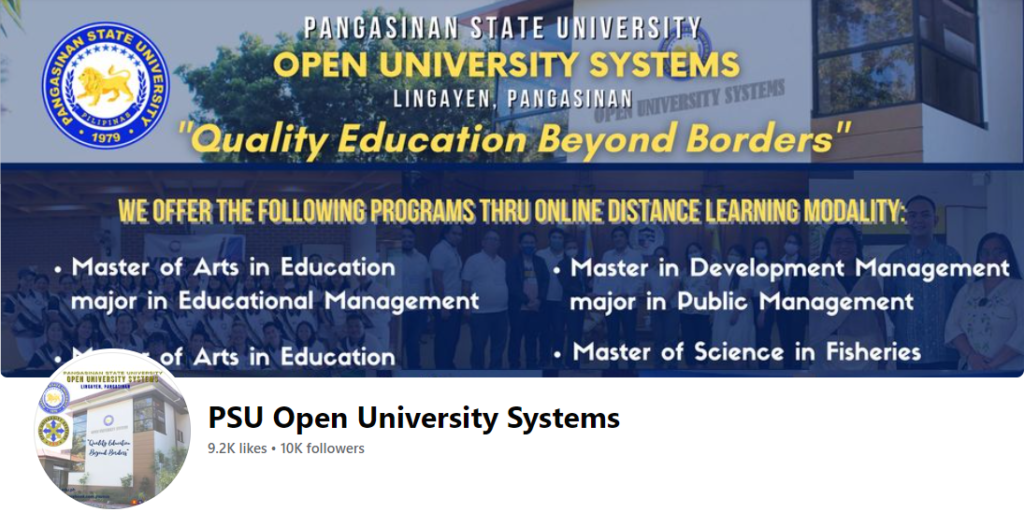
Pangasinan State University Open University Systems (PSU-OUS)
Pangasinan State University is one of the known universities outside Manila in the north with 8 strategically located campuses in the province. It is also one of the multi-awarded state universities in the whole country.
Besides the efficient implementation of the ETEEAP, it is also efficient in conducting and awarding graduate programs both on-campus and off-campus with their open university systems. To know more about them, you can visit their page with the image link below.
Philippine Christian University-Dasmariñas (PCU-Dasma)
Philippine Christian University-Dasmariñas is one of the campuses of PCU, a private university in the Philippines. This institution has produced quality students with their regular undergraduate programs and Bachelor of Science in Office Administration (BSOA) under their ETEEAP.
They also offer graduate degrees under their regular graduate programs which is open for Filipinos and foreign nationals.
Most state (and some private) universities offer Bachelor of Industrial Technology with the corresponding majors to the applicants’ skills under their ETEEAP. But what are these degree programs? Are they considered bachelors degree? And what are their equivalents?
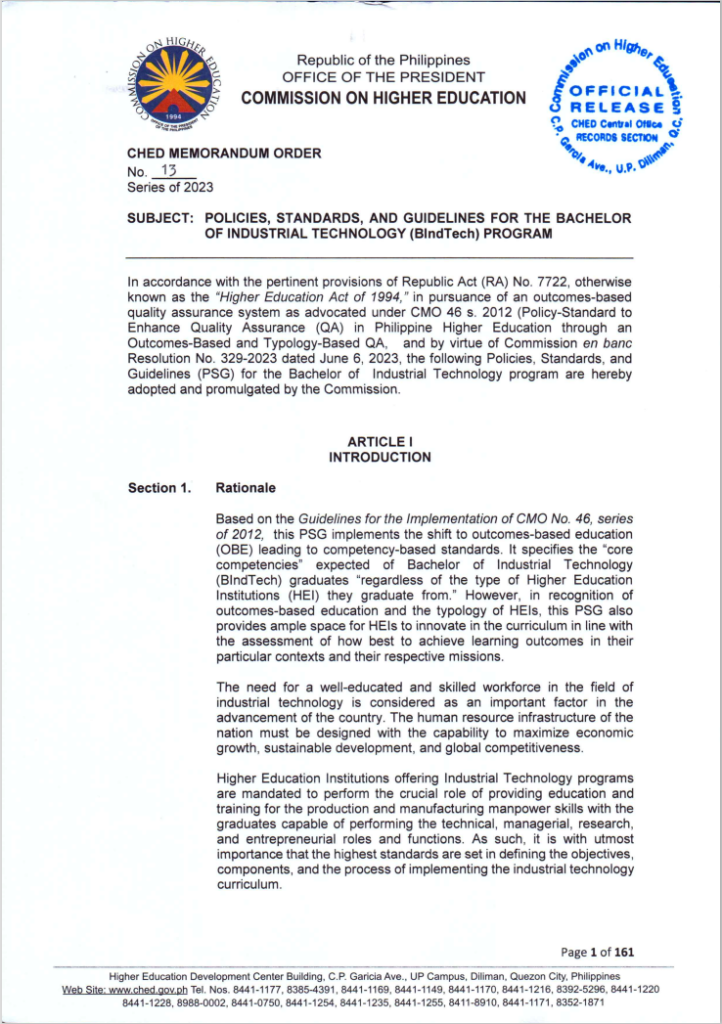
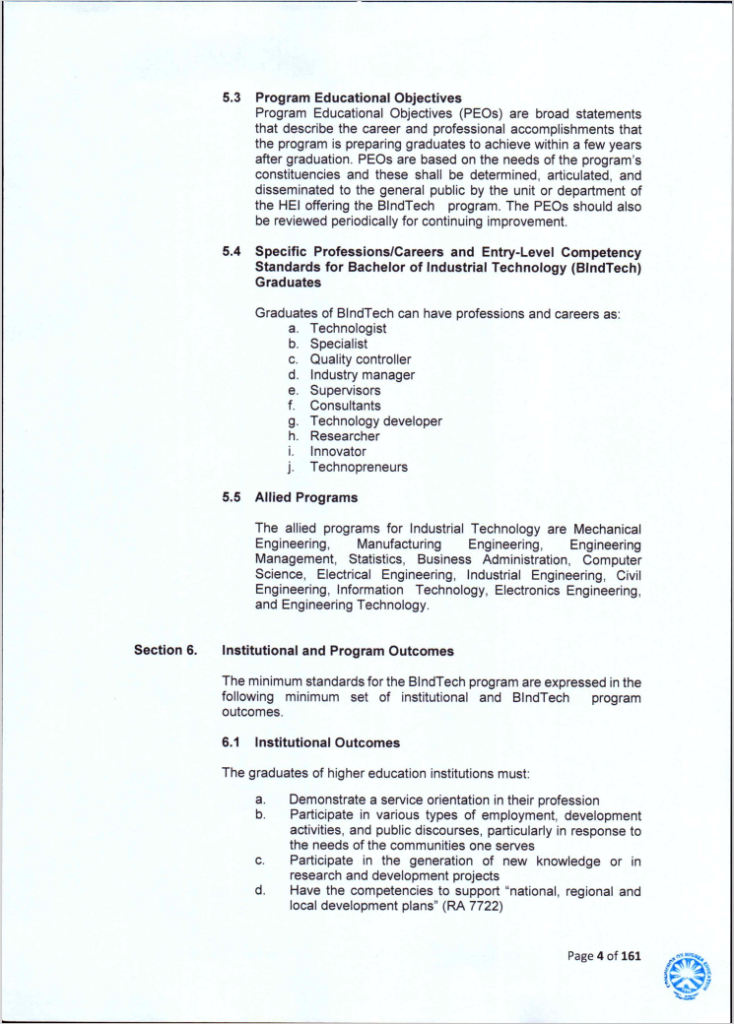
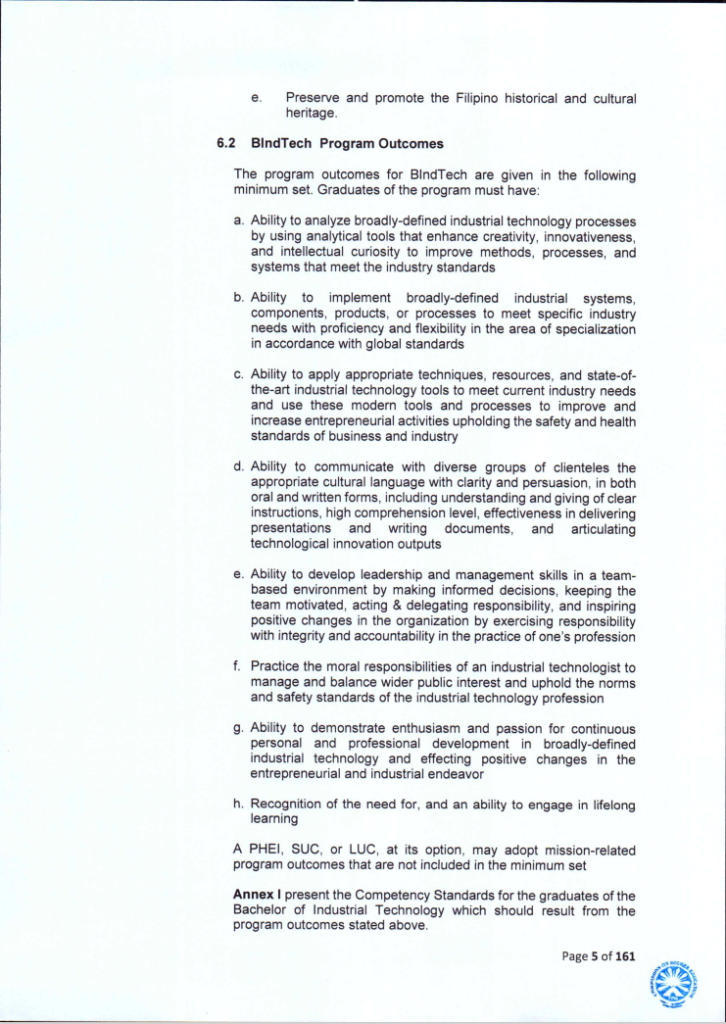
Let us take a closer look at this field. We will use the Commission on Higher Education Memorandum Order, which was signed and released on September 5, 2023 by CHED and called CMO-No-13-Series of 2023-BInd-Tech (CMO-13-S2023).
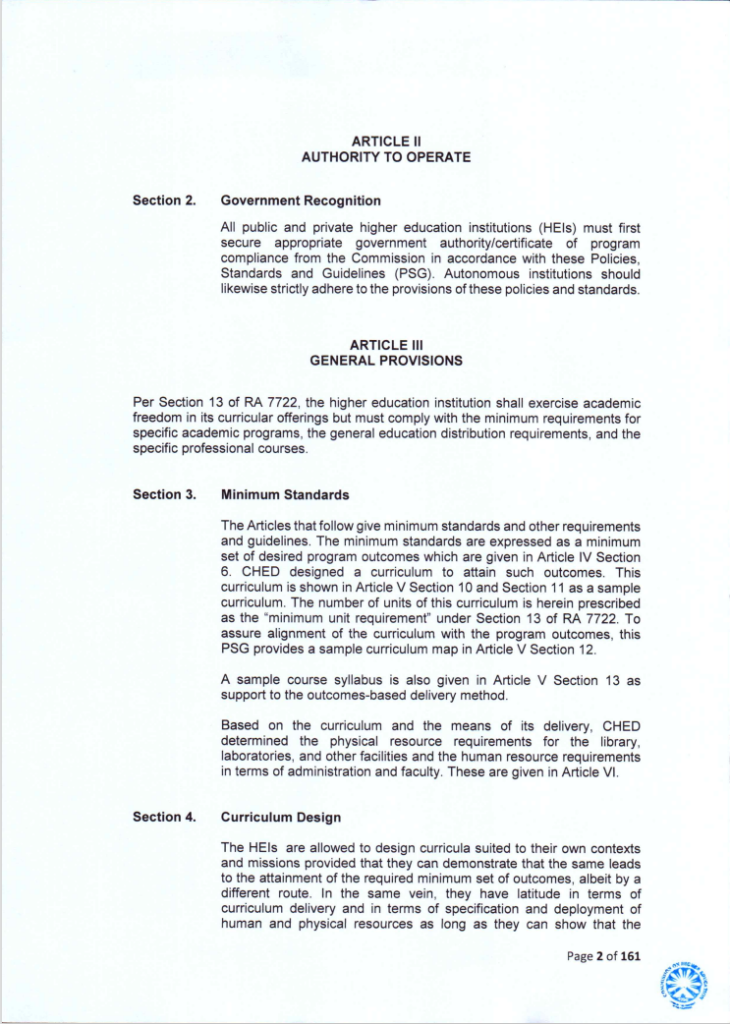
We only uploaded the image of the first 5 pages on this post as this is a 161-page document. If you want to see all the pages, you may click/tap on the links to either the CHED website or our resource page below. Documents from these links contain exactly the same information.
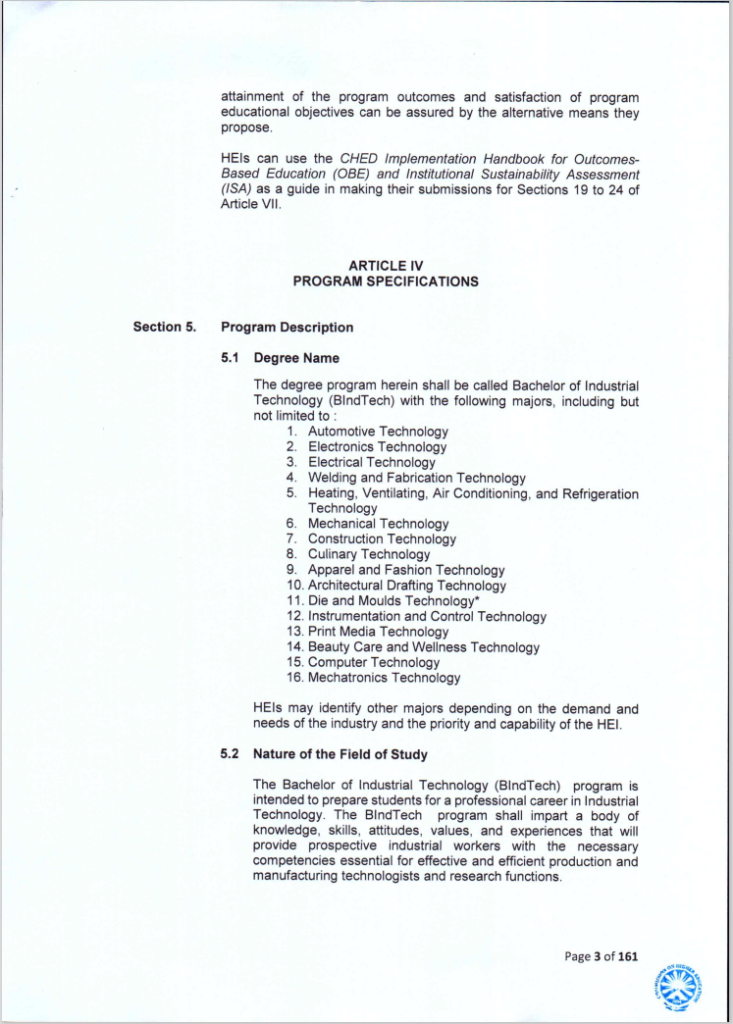
We don’t need to expound about this topic as the information on first 5 pages of the CMO on the following images are enough to explain what these programs are and their equivalent. Suffice to mention here the information found in the Article IV, Section 5.
Here is what it says:
ARTICLE IV PROGRAM SPECIFICATIONS
Section 5.Program Description
5.1 Degree Name The degree program herein shall be called Bachelor of Industrial Technology (BindTech) with the following majors, including but not limited to :
Automotive Technology
Electronics Technology
Electrical Technology
Welding and Fabrication Technology
Heating, Ventilating, Air Conditioning, and Refrigeration Technology
Mechanical Technology
Construction Technology
Culinary Technology
Apparel and Fashion Technology
Architectural Drafting Technology
Die and Moulds Technology
Instrumentation and Control Technology
Print Media Technology
Beauty Care and Wellness Technology
Computer Technology
Mechatronics Technology
HEls may identify other majors depending on the demand and needs of the industry and the priority and capability of the HEI. This means HEIs can come up with other nomenclatures for their programs as well as creating other, or combining different specializations into specific, majors.
5.2 Nature of the Field of Study The Bachelor of Industrial Technology (BindTech) program is intended to prepare students for a professional career in Industrial Technology. The BindTech program shall impart a body of knowledge, skills, attitudes, values, and experiences that will provide prospective industrial workers with the necessary competencies essential for effective and efficient production and manufacturing technologies, and research functions.
5.3 Program Educational Objectives Program Educational Objectives (PEOs) are broad statements that describe the career and professional accomplishments that the program is preparing graduates to achieve within a few years after graduation. PEOs are based on the needs of the program’s constituencies and these shall be determined, articulated, and disseminated to the general public by the unit or department of the HEI offering the BlndTech program. The PEOs should also be reviewed periodically for continuing improvement.
5.4 Specific Professions/Careers and Entry-Level Competency Standards for Bachelor of Industrial Technology (BlndTech) Graduates Graduates of BindTech can have professions and careers as:
Technologist
Specialist
Quality controller
Industry manager
Supervisors
Consultants
Technology developer
Researcher
Innovator
Technopreneurs
5.5 Allied Programs The allied programs for Industrial Technology are Mechanical Engineering, Manufacturing Engineering, Engineering Management, Statistics, Business Administration, Computer Engineering, Electrical Engineering, Industrial Engineering, Information Technology, Electronics Engineering and Engineering Technology.
Reference:CHED CMO No. 13, Series of 2023 – September 5, 2023
Schools that implement the program
One of the schools that is active in the above program is the Pangasinan State University. You may want to visit their page in the link below.